
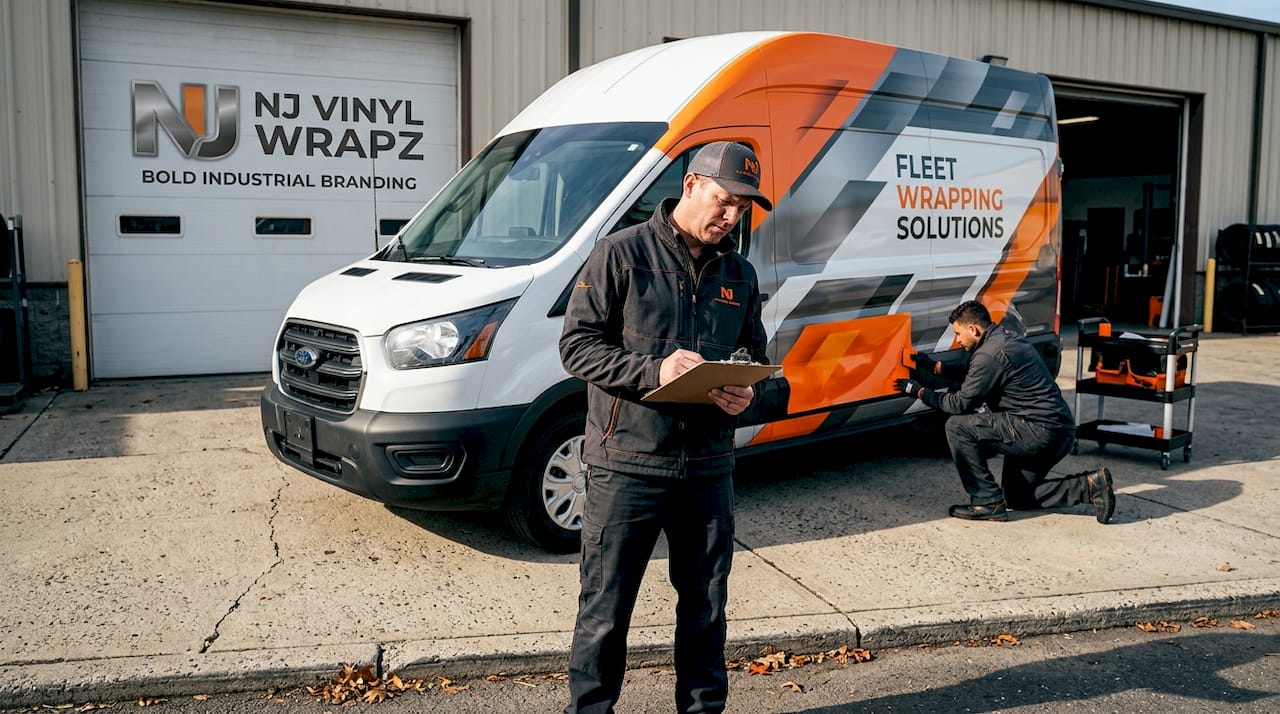
Most business owners assume decals and vehicle wraps are basically the same thing. They’re not, and that confusion costs companies real money. Choosing the wrong product for your fleet can mean wasted budget, weak brand visibility, or graphics that peel after one New Jersey winter. Decal installation is its own craft, with its own process, materials, and strategic uses. Whether you manage three vans or thirty trucks, understanding how decals work and when to use them puts your brand in a stronger position on every road your vehicles travel.
Table of Contents
- Understanding decal installation: What it is and why it matters
- Step-by-step: How professional decal installation works
- Tools and materials: What goes into quality decal installation
- Decal installation vs. vehicle wraps: Key differences for businesses
- Caring for your decals: Maintenance and durability tips
- The real-world impact: Lessons from NJ fleet branding experts
- Get expert decal installation for your NJ fleet
- Frequently asked questions
Key Takeaways
| Point | Details |
|---|---|
| Decal installation defined | Applying vinyl graphics or lettering boosts fleet brand visibility and professionalism. |
| Professional process matters | Expert installation ensures durability, long-term appeal, and protection for your vehicles. |
| Decals vs. wraps | Decals are best for targeted advertising, while wraps cover larger areas but come at higher costs. |
| Maintenance extends lifespan | Routine gentle cleaning and proper care help business decals outlast New Jersey’s weather. |
| Right provider, right results | Choosing experienced installers maximizes impact and value for your company’s vehicles. |
Understanding decal installation: What it is and why it matters
Decal installation is the professional process of applying pre-printed or cut vinyl graphics to a vehicle’s surface. These graphics can include your company logo, contact information, taglines, regulatory markings, or decorative elements. Unlike a full wrap, which covers the entire vehicle, decals target specific panels or areas with precision.
The primary goals of fleet decal installation fall into three categories:
- Advertising: Your vehicles become moving billboards. Every mile driven is exposure for your brand.
- Branding: Consistent visuals across every vehicle in your fleet create a professional, trustworthy image.
- Legal identification: Some industries require DOT numbers, business names, or license information displayed on commercial vehicles.
A common misconception is that decals are just stickers you can slap on and peel off without much thought. In reality, decal installation significantly boosts brand recognition for business fleets when done correctly. The difference between a professionally installed decal and a DIY application is visible from 50 feet away. Bubbles, misalignment, and poor adhesion are not just cosmetic problems. They communicate carelessness to every potential customer who sees your vehicle.
For New Jersey business owners specifically, the ROI on decal installation is hard to ignore. A branded vehicle driving through dense markets like Newark, Jersey City, or Trenton can generate thousands of visual impressions per day. When you explore vehicle lettering options for your fleet, you realize how cost-effective targeted decal placement can be compared to traditional advertising channels.
Many fleet managers also underestimate how much brand inconsistency costs them. If your trucks have mismatched fonts, faded logos, or outdated phone numbers, the fleet sends a fractured message. Decals applied consistently across all vehicles solve that problem immediately.
Step-by-step: How professional decal installation works
Now that you know what decal installation accomplishes, here’s how the process unfolds in the hands of experts.
Professional installing vehicle decals is not a one-step operation. Every stage requires skill, patience, and the right environment. Here is what to expect:
- Initial consultation and design review. The process starts with a conversation about your goals, brand guidelines, and vehicle specifications. A good installer will review your logo files, suggest sizing, and flag any design issues before printing begins.
- File preparation and printing. Once the design is approved, it goes to print using high-resolution digital printers. Color accuracy and sharpness at this stage determine how your decal looks on the road.
- Surface preparation. This step is where many DIY applications fail. The vehicle surface must be cleaned thoroughly with isopropyl alcohol or dedicated surface prep solutions to remove wax, grease, and debris. Any contamination under a decal will cause it to lift and fail prematurely.
- Precise positioning. Proper preparation and expert application are essential for flawless decal installation. Installers use tape hinge methods or wet application techniques to position the decal exactly where it needs to go before committing to the surface.
- Application and squeegee work. Once positioned, the decal is pressed firmly onto the surface using professional squeegees, working from the center outward to eliminate air pockets. This step requires steady pressure and consistent technique.
- Transfer tape removal. After application, the transfer tape or paper liner is carefully peeled away at a low angle to avoid lifting the decal edges.
- Final inspection. The finished surface is checked for bubbles, lifting edges, and alignment. Any issues are corrected before the vehicle leaves the shop.
- Post-installation care instructions. Reputable fleet wrap experts will walk you through what to do and avoid in the first 48 to 72 hours after installation, such as keeping the vehicle out of rain or automatic car washes.
Pro Tip: Never skip surface preparation, even on a brand-new vehicle. Factory paint often has mold release agents or protective coatings that interfere with vinyl adhesion. A quick wipe-down with the right prep solution before application can add years to your decal’s life.
Tools and materials: What goes into quality decal installation
Understanding the process is only part of the equation. The right tools and materials ensure lasting results, and there is a clear gap between what professionals use and what you find in a hardware store.
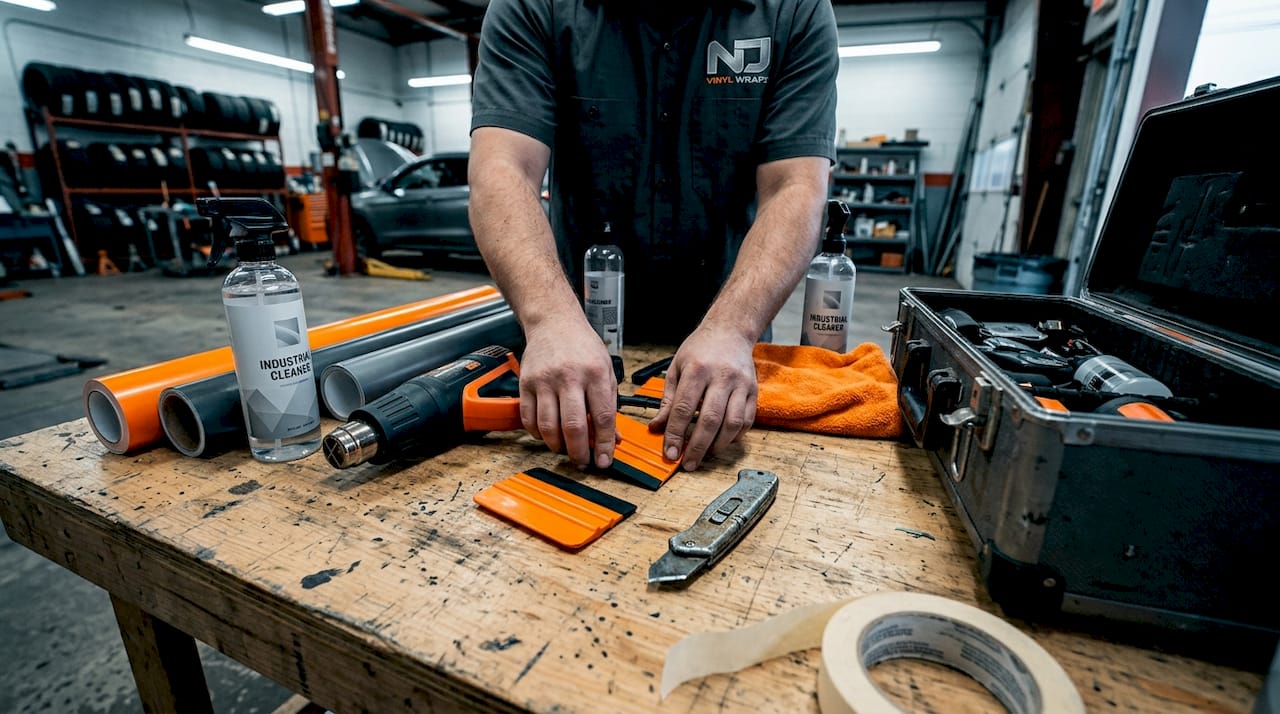
Here are the essential tools used in professional decal installation:
- Squeegees: Hard felt-edged squeegees are used to press the vinyl firmly and eliminate air bubbles without scratching the surface. Soft squeegees work on curved panels.
- Heat guns: Low-heat application helps vinyl conform to complex curves, door handles, and body lines without stretching or tearing.
- Surface prep solutions: Isopropyl alcohol and dedicated automotive prep sprays remove contaminants that prevent proper adhesion.
- Precision knives and cutters: These tools trim excess material cleanly, especially around panel edges, mirrors, and door seams.
- Application tape and transfer paper: These hold the decal in the correct configuration during positioning and initial application.
Using professional-grade vinyl films, squeegees, and surface cleaners ensures longevity and seamless appearance. The vinyl itself matters enormously. Cast vinyl films from brands like 3M and Avery are engineered for outdoor durability, UV resistance, and long-term color stability. Calendered vinyl is cheaper but thicker and less flexible, which makes it prone to cracking and lifting, especially on curved surfaces or in temperature extremes.
New Jersey’s climate is not gentle. Summers hit high humidity and direct sun. Winters bring road salt, freeze-thaw cycles, and snow. Calendered films simply do not hold up well under those conditions. For fleet vehicles that stay on NJ roads year-round, cast vinyl is the professional standard.
The tools used for fleet graphics share similarities with specialty vinyl films used in interior and commercial applications. If you’ve ever looked at professional floor graphics or window graphic tools, you’ll notice the same precision equipment used across all these surfaces because the goal is always the same: clean adhesion, no bubbles, and a finish that lasts.
Decal installation vs. vehicle wraps: Key differences for businesses
Choosing between decals and wraps is often the biggest decision fleet managers face. Here is how they stack up side by side.
The core difference is coverage. Decals are applied to specific sections of a vehicle. Wraps cover large surface areas or the entire vehicle. Both deliver branding results, but the right choice depends on your budget, your goals, and how aggressively you want to market through your fleet.
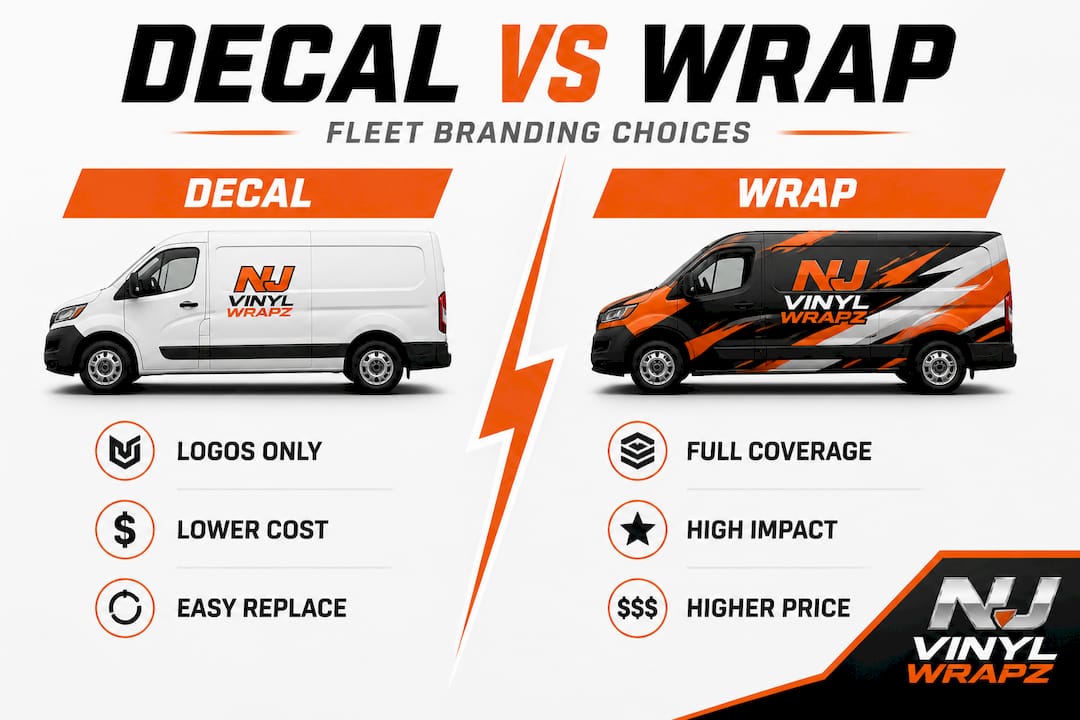
Both decals and wraps offer branding solutions but differ in coverage, cost, and installation time. Here is a direct comparison to help you decide:
| Feature | Decals | Partial wraps | Full wraps |
|---|---|---|---|
| Coverage area | Targeted panels or sections | 25% to 75% of vehicle surface | Entire vehicle exterior |
| Cost range | Lower (budget-friendly entry) | Mid-range | Higher investment |
| Installation time | Hours | 1 to 2 days | 2 to 5 days |
| Branding impact | Strong for key info and logos | High visibility on major panels | Maximum visual impact |
| Best for | Contact info, logos, DOT numbers | Side panels, hoods, tailgates | Fully branded fleet vehicles |
| Removability | Easy with professional removal | Straightforward | Requires professional care |
When should you choose each option?
- Decals: Ideal when your budget is limited, you need specific regulatory markings, or you want to add branding to a new vehicle quickly without a full commitment.
- Partial wraps: A smart middle ground for companies that want strong visual impact on major panels without covering the full vehicle. Great for vans and pickup trucks.
- Full vehicle wraps: Best for companies that want to make a bold statement and maximize mobile advertising across every surface. Often the most cost-effective per-impression advertising available.
- Fleet wrap services: When you’re outfitting multiple vehicles, a professional fleet program ensures consistent branding across your entire operation.
If you are focused on aesthetics for a personal or specialty vehicle rather than fleet branding, color change wraps offer a completely different application of the same vinyl technology.
Factors to weigh before committing: How many vehicles are in your fleet? Does your industry require specific markings? How long do you plan to keep your current vehicles? What is your monthly advertising budget compared to a one-time installation cost?
Caring for your decals: Maintenance and durability tips
Once your decals are installed, proper care ensures you get the most out of your visual investment.
Routine cleaning and gentle handling help decals last for years, even under demanding business use. That does not require a complicated routine. It just requires consistency and a few habits that most fleet managers can easily adopt.
Here is what to do and avoid:
- Do wash regularly: Road grime, salt, and bird droppings are chemically corrosive to vinyl. Hand washing every one to two weeks with a gentle automotive soap keeps the surface clean and protects adhesion.
- Do rinse thoroughly: Soap residue left on the surface can dull the appearance and accelerate fading over time.
- Avoid automatic car washes with brushes: The mechanical friction from brush-style car washes can lift decal edges and cause peeling, especially on corners and panel edges.
- Avoid harsh chemicals: Solvents, acetone, and petroleum-based cleaners will damage the vinyl’s surface coating, leading to discoloration and brittleness.
- Do park in shade when possible: UV exposure is one of the primary causes of fading. Covered parking significantly extends the life of your graphics.
- Avoid pressure washing at close range: High-pressure streams aimed directly at decal edges can force water underneath and break the bond.
New Jersey’s road salt is a particular threat to fleet graphics during winter. After snowy or salted road conditions, rinse the vehicle as soon as possible. Salt accelerates edge lifting and can work its way under the film along seams.
Pro Tip: If you notice a small edge starting to lift, do not peel it back or try to re-press it with your fingers. Heat guns at low settings can reactivate the adhesive and seal the edge back down cleanly. This quick fix done early prevents a larger problem later.
Knowing when to refresh or replace your decals is just as important as maintenance. If the color has faded noticeably, the edges are curling, or the design no longer reflects your current brand identity, it’s time for an update. For guidance on caring for commercial decals and knowing when replacement makes more sense than repair, professional consultation is always worth the conversation.
The real-world impact: Lessons from NJ fleet branding experts
Here is an honest look at what actually moves the needle for New Jersey businesses when it comes to fleet decals, and what most companies get wrong.
The biggest mistake we see is not skimping on materials or skipping professional installation, though both happen frequently. The most common problem is that business owners rush the design stage. They hand over a low-resolution logo, skip the proof review, or try to cram too much information onto a single panel. The result is a vehicle that looks cluttered and is hard to read at highway speed. A decal that cannot be read in three seconds has failed its primary job.
Quality decals, used strategically, can outperform full wraps in specific scenarios. If your vehicles operate in an area where they spend a lot of time parked and visible, a well-designed door decal with your logo, phone number, and website can generate more leads than a busy full wrap that overwhelms the eye. Simplicity and strategic placement often beat sheer coverage.
Thoughtful design placement matters more than most people expect. The driver’s door panel is the most frequently viewed surface in urban environments. The rear of the vehicle gets significant attention in traffic. The hood and roof matter far less in most business contexts. Prioritizing placement based on real-world visibility conditions is something experienced installers advise on regularly, and it’s advice worth taking.
There’s also the ongoing brand review question. Fleet vehicles change. Companies rebrand. Contact numbers change. A decal program that was perfectly aligned with your brand two years ago may be sending mixed signals today. Reviewing your fleet wrap case studies and comparing them against your current brand standards at least once a year keeps your fleet working as hard as it should. A dated vehicle tells customers your business isn’t current. An updated, sharp fleet tells them you mean business.
Get expert decal installation for your NJ fleet
If decal installation has felt like a complex process to navigate on your own, that’s exactly why working with experienced local professionals makes such a difference.
At NJ Vinyl Wrapz, we’ve spent over 10 years helping New Jersey business owners and fleet managers get their branding exactly right. From professional vehicle lettering that makes your contact information impossible to miss, to fully integrated fleet wrap services that brand every vehicle in your operation with consistency and precision, we handle every stage in-house. Our climate-controlled facility, licensed team, and partnerships with 3M and Avery mean your fleet gets the quality it deserves. Explore the full range of NJ Vinyl Wrapz solutions and schedule your consultation today.
Frequently asked questions
How long do vehicle decals typically last in New Jersey weather?
With professional installation and proper care, high-quality vehicle decals can last 3 to 7 years, even through NJ’s hot summers and snowy winters. Routine cleaning and gentle handling are the biggest factors in reaching that upper range.
Is there a difference between a decal and a wrap?
Yes, decals are graphics or lettering applied to specific parts of the vehicle, while wraps cover all or most of the vehicle’s surface. Both decals and wraps offer branding solutions but differ in coverage, cost, and installation time.
Can decals be removed without damaging the vehicle’s paint?
Professional decal removal should not damage original automotive paint when high-quality materials are properly installed. Professional-grade vinyl films are engineered to release cleanly without leaving adhesive residue or lifting paint when removed correctly.
How do I maintain decals installed on my fleet vehicles?
Keep decals clean with gentle, non-abrasive washing and avoid harsh chemicals to maximize their usable life. Routine cleaning and gentle handling help decals last for years, even under the demands of daily commercial use in New Jersey.