

High-quality printing is defined as the production of printed materials with sharp text, accurate color reproduction, and consistent finishes that reflect a brand’s professional standards. For business owners and marketers, why high-quality printing decisions get made matters more than most realize. Up to 90% of purchasing decisions are influenced by color perception. That single fact means your printed materials are doing sales work before a customer ever speaks to you. Print quality is not a design preference. It is a business variable with measurable consequences.
How does print quality impact brand recognition and customer trust?
Print quality shapes how customers perceive your business before they read a single word. 75% of people recall brands from printed materials, compared to 44% from digital ads. That 31-point gap is not a coincidence. It reflects how the brain processes physical objects differently from screen-based content.
The psychological mechanism is straightforward. When a customer holds a business card printed on heavy stock with a matte finish, their brain registers weight, texture, and color simultaneously. Each of those signals feeds a subconscious judgment about your business. Print quality acts as a trust-building tool that communicates professionalism before any direct engagement occurs. Poor quality does the opposite. Faded ink, misaligned text, or washed-out colors signal cheapness and unreliability instantly.
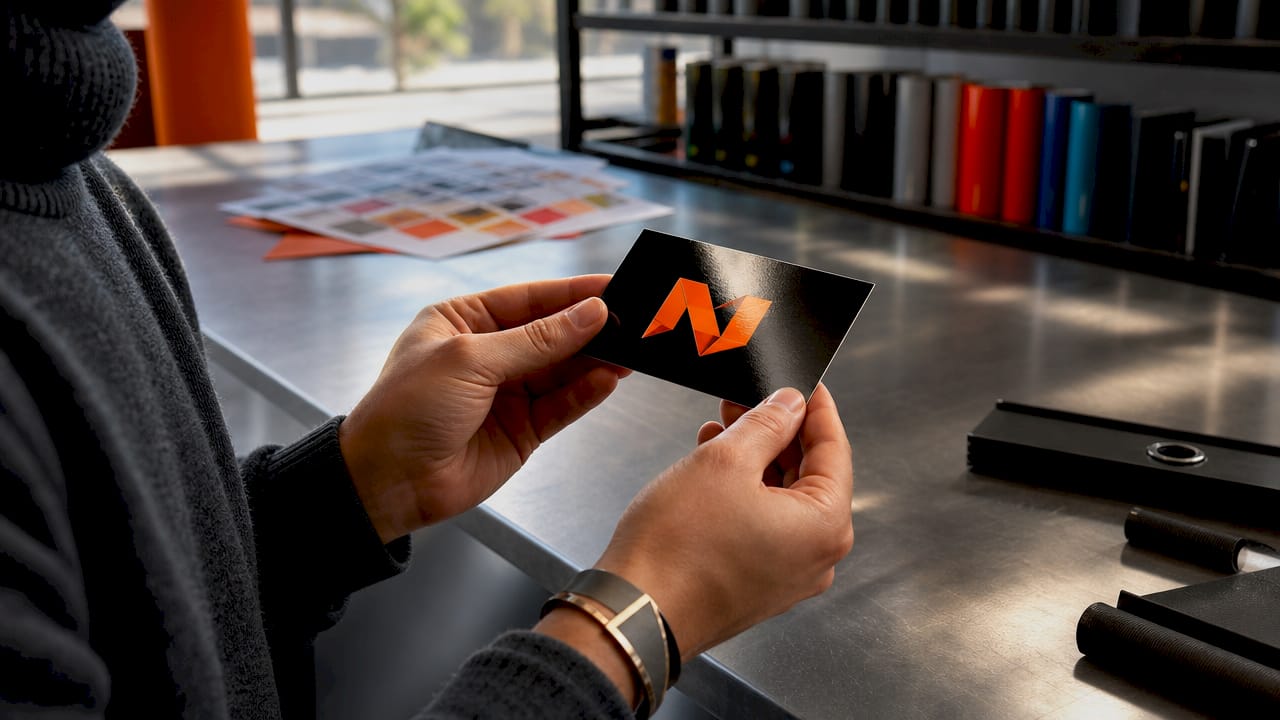
Color consistency plays a specific role in this trust equation. When your brand colors shift between a brochure, a vehicle wrap, and a banner, customers notice the inconsistency even if they cannot name it. Consistency in print materials reduces cognitive friction and reinforces brand authenticity. That consistency makes customers more comfortable and more loyal over time.
Key signals that build or break trust through print:
- Paper weight and texture: Heavier stock signals investment and seriousness.
- Color accuracy: Off-brand colors create doubt about attention to detail.
- Finish quality: Smudged or uneven coatings suggest low production standards.
- Registration accuracy: Misaligned layers indicate poor press control.
“Print quality is a subconscious proxy for service quality. Customers make judgments about your entire operation based on the materials you hand them.”
The implication for fleet branding is direct. A vehicle wrap with dull colors or visible banding tells every driver on the road that your business cuts corners. A sharp, vibrant wrap with consistent brand colors tells them the opposite. The print quality on your vehicles is a moving advertisement for your standards.
What technical factors define high-quality printing?
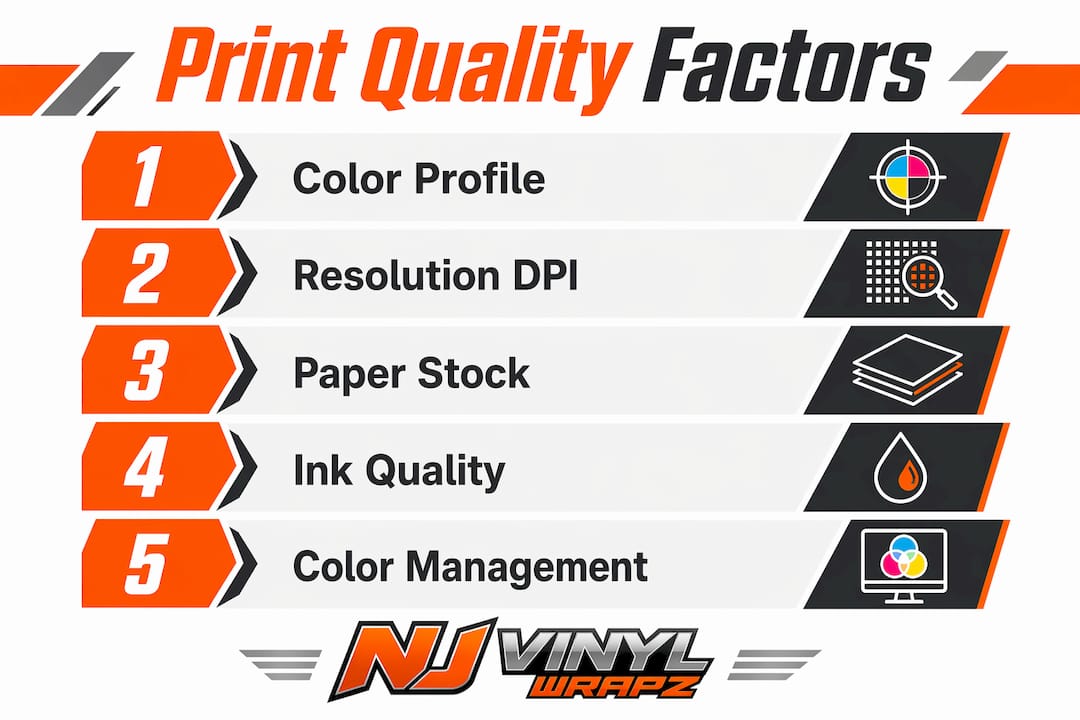
Print quality is the result of several technical decisions made before the job ever reaches the press. Getting these right separates professional results from disappointing ones.
Color profiles: RGB vs. CMYK
Screens display color using RGB, a system based on emitted light. Printers use CMYK, a system based on ink absorption on paper. Failing to convert RGB files to CMYK is the most common cause of color shifting in digital-to-print workflows. A vivid blue on your screen can print as a dull purple if the conversion is skipped or done incorrectly. Always supply print-ready CMYK files to your print provider.
Resolution and DPI requirements
DPI stands for dots per inch. It measures how many ink dots a printer places per inch of material. For standard printed materials like brochures and business cards, 300 DPI is the minimum for sharp results. Large-format prints such as vehicle wraps and banners are viewed from a distance, so 72–150 DPI is typically sufficient. Submitting a low-resolution file for a close-up print produces visible pixelation and blurry edges.
Paper stock and finishes
Paper stock choice influences perceived value through tactile impressions of reliability and quality. A 100 lb. gloss cover stock feels premium. A thin, uncoated sheet feels disposable. Finishes like soft-touch laminate, UV coating, and spot gloss each add a layer of sensory information that reinforces brand positioning.
| Technical factor | Standard quality | Professional quality |
|---|---|---|
| Color profile | RGB files submitted | CMYK files, press-matched |
| Resolution | 72 DPI | 300 DPI (or appropriate for format) |
| Paper stock | Uncoated, lightweight | Coated, weighted, finish-selected |
| Color management | None applied | Color management system used |
Color management systems
Professional print shops use color management systems to keep brand colors accurate and consistent across multiple materials and substrates. These systems calibrate the press to a known color standard, preventing brand fragmentation when the same job runs on different equipment or at different times. Without color management, your brand red on a business card will not match your brand red on a banner.
Pro Tip: Request a physical press proof before approving any large print run. A digital proof on screen cannot replicate how ink behaves on your chosen substrate.
How does print quality compare to digital presentations?
Print and digital media operate on fundamentally different physical principles. Understanding the difference helps you use each medium more effectively.
Print relies on reflected light and texture, while digital screens emit light directly into the viewer’s eyes. This distinction affects how colors appear, how sharp edges look, and how long the impression lasts. A printed piece with a gloss finish catches ambient light and changes slightly as the viewer moves. A screen displays the same pixel regardless of viewing angle. Neither is superior in every context. They create different perceptual experiences.
Why print engages more senses
Physical print materials evoke stronger emotional connections than digital campaigns because they engage multiple senses simultaneously. You see the color, feel the texture, and register the weight. Digital media engages only sight and sometimes sound. That multi-sensory engagement is why a well-printed brochure creates a more lasting memory than a banner ad.
| Dimension | Digital screen | |
|---|---|---|
| Color system | CMYK, reflected light | RGB, emitted light |
| Tactile engagement | Yes, texture and weight | No |
| Viewer control | Physical, holds attention | Scrolled past quickly |
| Emotional resonance | Higher, multi-sensory | Lower, single-sense |
| Color consistency | Press-controlled | Screen-dependent |
Digital screens also vary widely in color calibration. A customer viewing your digital ad on an uncalibrated monitor sees different colors than one on a professional display. A printed piece, produced with proper color management, delivers the same color to every viewer.
Pro Tip: Coordinate your print and digital assets by building your brand palette in CMYK first, then converting to RGB for screen use. This approach prevents the more common and damaging reverse error.
What are the practical business benefits of investing in premium printing?
The business case for premium printing is straightforward. A slight improvement in print quality can disproportionately increase business impact, making it a cost-effective investment rather than a line-item expense. The math works because print quality affects customer perception at every touchpoint, not just at the moment of delivery.
Here are the concrete advantages businesses gain from prioritizing print quality:
- Higher perceived credibility. Customers associate well-printed materials with well-run businesses. A premium business card or a sharp vehicle wrap signals that you invest in your brand, which implies you invest in your customers.
- Better conversion rates. When printed materials look professional, they are more likely to be kept, shared, and acted upon. A flimsy flyer gets discarded. A well-produced one gets pinned to a board.
- Longer material lifespan. Premium inks and substrates resist fading, cracking, and wear. A vehicle wrap printed on 3M or Avery vinyl with UV-resistant inks maintains its appearance for years, not months. That longevity extends the return on your print investment.
- Consistent brand presence. When every printed touchpoint matches, from your fleet vehicles to your business cards, customers build a coherent mental image of your brand. That coherence builds recognition faster than any single campaign.
- Reduced reprint costs. Poor quality prints often require reprints due to color errors, registration failures, or substrate incompatibility. Investing in quality upfront eliminates most of these failures.
The vehicle wrap context makes this especially clear. A fleet of vehicles wrapped with professional commercial wrap design and premium print quality generates thousands of daily impressions. Each impression either builds or erodes brand trust. The print quality decision is made once and then works for years.
Pro Tip: Treat your print budget as a brand infrastructure cost, not a marketing expense. Infrastructure investments are evaluated on longevity and reliability, not just immediate return.
Key takeaways
Premium print quality is the single most cost-effective way to build brand credibility, because it works at every customer touchpoint simultaneously and continues working long after the initial investment.
| Point | Details |
|---|---|
| Print outperforms digital for recall | 75% of people recall brands from print vs. 44% from digital ads. |
| Color accuracy drives purchasing decisions | Up to 90% of purchasing decisions are influenced by color, making CMYK accuracy non-negotiable. |
| CMYK conversion prevents color errors | Always convert RGB files to CMYK before submitting to a print provider to avoid color shifts. |
| Paper stock signals brand value | Heavier, coated stock creates a subconscious impression of quality and reliability. |
| Consistency builds brand authenticity | Matching colors across all print materials reduces cognitive friction and strengthens recognition. |
Print quality is the brand signal most businesses ignore
I have watched businesses spend significant budgets on logo design and digital advertising, then hand a prospect a business card that feels like it came from a home printer. That disconnect destroys the credibility the design budget was meant to build. Print quality is the last mile of brand communication, and most businesses treat it like a commodity.
The misconception I see most often is that print quality is about aesthetics. It is not. It is about trust signals. When a fleet manager hands a potential client a folder with a vehicle wrap photo on the cover, the paper weight and color accuracy of that folder are communicating something about the quality of the wrap itself. Customers make that connection subconsciously, and it influences their decision.
My recommendation is to audit every physical touchpoint your brand produces. Check whether your brand colors match across business cards, brochures, and vehicle graphics. Check whether your paper stocks reflect the positioning you want. Check whether your print provider uses a color management system or just eyeballs it. These are not design questions. They are brand strategy questions.
Businesses that treat print as a key brand communication channel see compounding returns. Every consistent, high-quality impression reinforces the last one. Every inconsistent or low-quality impression erodes the work done before it. The investment in quality printing is not a one-time cost. It is the foundation of a brand that customers recognize and trust.
— Krunal
How Njvinylwrapz delivers print quality for fleet brands
For businesses that need print quality to perform outdoors, at scale, and over years rather than weeks, vehicle wraps are the highest-leverage print investment available.
Njvinylwrapz produces full vehicle wraps using premium materials from 3M and Avery, with color management processes that keep your brand colors consistent across every vehicle in your fleet. Every wrap is printed and installed in a climate-controlled facility, which prevents the adhesion failures and color inconsistencies that outdoor installations produce. With over 10 years of experience in fleet wrap services across New Jersey, Njvinylwrapz applies the same print quality standards to a single vehicle or an entire commercial fleet. Contact Njvinylwrapz to see how professional print quality translates directly into brand visibility on the road.
FAQ
Why does print quality affect brand trust?
Print quality acts as a subconscious trust signal before any direct engagement occurs. Customers associate the quality of your printed materials with the quality of your products and services.
What is the difference between RGB and CMYK in printing?
RGB is a color system used by screens that emits light, while CMYK is the system used by printers that applies ink to absorb light. Submitting RGB files to a print provider without conversion causes color shifts in the final output.
What DPI is required for professional print results?
300 DPI is the standard for close-up printed materials like business cards and brochures. Large-format prints like vehicle wraps are viewed from a distance and typically require 72–150 DPI for sharp results.
How does print quality compare to digital advertising for brand recall?
Print produces 31% higher brand recall than digital advertising. 75% of people recall brands from printed materials versus 44% from digital ads.
Is investing in premium printing cost-effective for small businesses?
A small improvement in print quality produces a disproportionately large improvement in perceived professionalism. Premium printing also reduces reprint costs and extends the lifespan of marketing materials, making it a sound long-term investment.