
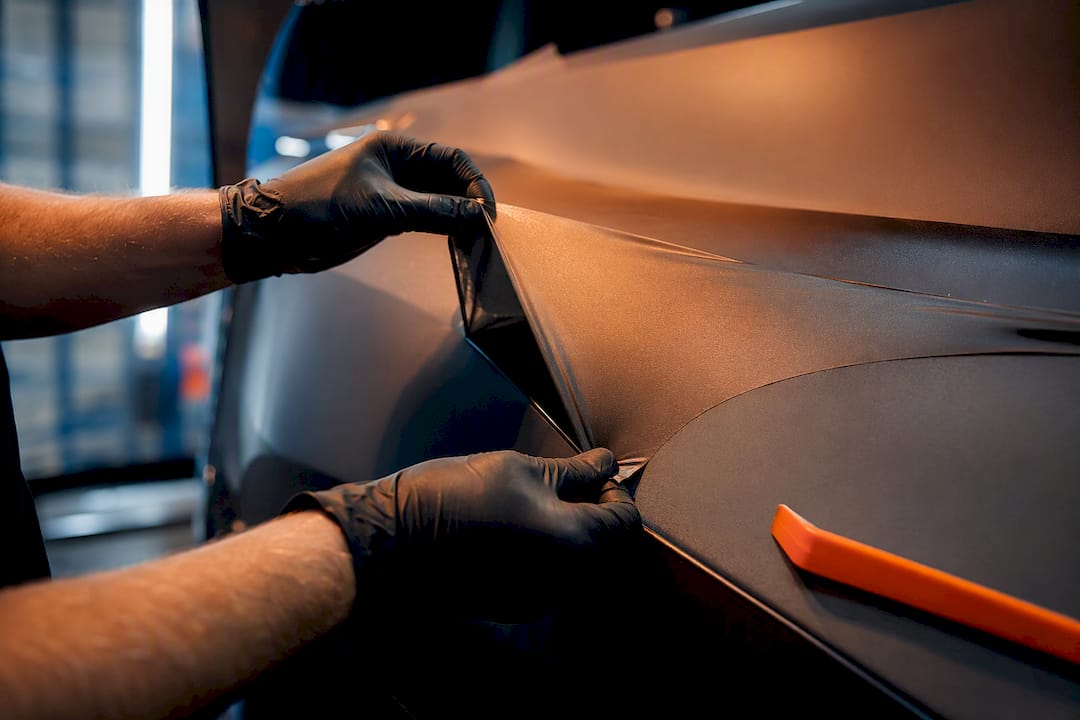
Yes, you can wrap a leased car, and most lessors allow it because a vinyl wrap is fully reversible. The condition that actually matters is proof: get written approval from the leasing company, document your paint before installation, and budget for professional removal before the lease ends. Skip any one of those steps and you’re gambling with excess wear fees.
TL;DR:
- Written approval from the lessor is essential before wrapping a leased car, and vague requests may lead to disputes at return.
- A pre-install paint inspection report and detailed documentation of the vehicle’s condition are critical for protecting against damage charges.
- Using premium cast vinyl from reputable brands ensures clean removal and minimizes risks of damaging the factory paint during wrap removal.
- Scheduling professional removal several weeks before lease end and keeping all receipts and photos can prevent costly fees and disputes.
- Subtle color choices, partial wraps, and finishes that closely match factory paint reduce inspection problems, but still require prior approval.
Table of Contents
- How Leases Treat Reversible Cosmetic Changes
- Pre-Install Checklist: What Installers and Lessors Will Look For
- Paint Condition and the Main Risks to Lease Returns
- Choosing Materials and a Professional Installer for Lease-Safe Wraps
- Removal Timing, Costs, and the Lease-Return Workflow
- Insurance, Documentation, and What to Tell the Dealer at Turn-In
- NJ Vinyl Wrapz’s Lease-Safe Workflow, and What to Ask Any Installer
- Wrapping Different Vehicle Types: SUVs, Sedans, and Trucks
- Preparing the Surface Before Wrapping
- Legal Considerations for Modifying a Leased Vehicle
- Choosing Colors and Finishes That Won’t Raise Flags
- Handling Damage Found During Wrap Removal
- What Actually Protects You When You Wrap a Leased Car
- Get a Lease-Check Consultation Before You Wrap
- Sources
- FAQ
How Leases Treat Reversible Cosmetic Changes
Lease contracts are built around one idea: the car has to come back looking like it left. Most agreements define “excess wear” broadly enough to cover anything the leasing company didn’t approve, and inspection usually happens 60 to 90 days before the lease ends, giving you a narrow window to fix problems.
A wrap sits in a different category than a permanent modification. Bolt-on body kits, drilled panels, or a repaint change the car’s physical structure. A properly installed vinyl wrap doesn’t touch the factory clearcoat and can be peeled off entirely, which is exactly why most lessors treat it as reversible rather than a lasting mod.
That distinction only protects you if it’s on paper. A verbal “sure, go ahead” from a salesperson means nothing to the finance company that owns the title.
- Written approval, even a short email confirmation, becomes your evidence at turn-in.
- Verbal approval from a dealership employee is not binding on the leasing company.
- Approval requests should specify the wrap type (full color change, partial, or graphics) since some lessors treat them differently.
Pre-Install Checklist: What Installers and Lessors Will Look For
Before a single panel gets wrapped, build the paper trail that protects you later. This is the step most lessees skip, and it’s the one that decides whether turn-in goes smoothly or turns into a fee dispute.
- Read your lease’s alteration clause. Find the exact language on modifications and email the leasing company directly, not just the dealer, asking for written approval to wrap a leased car temporarily.
- Save every reply. Written lessor approval paired with installer documentation is the strongest protection you can have if a dispute comes up at return.
- Photograph every panel. Use high-resolution, dated photos, and log the VIN, current mileage, and the date in the same file.
- Get a paint inspection report. A reputable installer should document panel condition before wrapping. A dated pre-install inspection is often the single piece of proof that prevents a surprise charge.
- Flag risky panels. If a fender or hood shows chipping, hazing, or a prior respray, ask whether it should be skipped or handled with extra care.
Pro Tip: Email your lessor a short, specific request rather than a vague one. “I’d like to install a removable vinyl wrap and remove it professionally before lease end” gets a faster, more useful answer than “Can I customize my car?”
Paint Condition and the Main Risks to Lease Returns
The real danger with wrapping a leased car isn’t the wrap itself. It’s what’s underneath it. Vinyl adhesive bonds to whatever surface it’s given, and if that surface is already compromised, removal can pull paint off with the film.
Failing clearcoat is the biggest culprit. Once clearcoat starts to break down from UV exposure or age, it loses its ability to hold together as one layer. A wrap applied over that surface can accelerate delamination, and pulling the vinyl later may lift flakes of clearcoat with it. Resprayed panels carry a similar risk, since aftermarket paint jobs often don’t bond to the substrate the way factory finishes do.
Installers check for a few telltale signs before they’ll commit to a full install:
- Bubbling or soft spots that suggest moisture trapped under old paint
- Uneven texture or sheen that signals a partial repaint
- Chipping near edges, mirrors, or door handles that indicates clearcoat failure
A test strip applied to a hidden panel for 24 to 48 hours is a cheap way to catch a bad reaction before it happens across the whole car. When done right, a wrap can actually protect factory paint from stone chips and UV damage, sometimes leaving the finish in better shape at turn-in than it would have been bare.
Choosing Materials and a Professional Installer for Lease-Safe Wraps
Not all vinyl is built the same, and the difference matters a lot more on a leased car than it does on one you own outright. Premium cast vinyl from brands like 3M or Avery Dennison is engineered to remove cleanly from healthy factory paint, which is exactly what a lease-return inspection demands. Cheaper calendared film is thinner, more rigid, and far more likely to leave adhesive residue or tear during removal.
Cast film also tends to hold its color and finish longer, with a typical lifespan of 5 to 7 years compared to standard lease terms of 24 to 36 months. That gap gives you a buffer if your lease gets extended slightly.
Vet your installer with the same rigor you’d apply to picking a mechanic:
- Licensed and insured, with proof available on request
- Climate-controlled install bay (temperature and dust control affect adhesion quality)
- Written warranty on materials and labor
- Offers a documented removal package, not just installation
Pro Tip: Ask directly about the removal-day process before you sign for installation. A shop that can’t describe its wash, heat, and adhesive-cleanup steps in detail probably hasn’t done many lease returns.
Removal Timing, Costs, and the Lease-Return Workflow
Timing removal wrong is one of the most common (and avoidable) mistakes lessees make. Pull the wrap too late and you won’t have time to fix a problem before inspection. Schedule removal several weeks before your lease-return date to allow enough time for adhesive cleanup, detailing, and a second inspection of the paint.
Shops frequently sell dedicated lease-return removal packages, which exist specifically because DIY removal is where most paint damage happens. Trying to peel a wrap yourself with a heat gun and a credit card is how clearcoat gets scratched.
| Factor | Effect on Removal Cost |
|---|---|
| Film age | Older film bonds harder and takes longer to remove |
| Coverage size | Full wraps cost more to remove than partial wraps or accents |
| Panel damage | Pre-existing clearcoat issues add labor and risk |
| Film quality | Premium cast vinyl generally removes faster and cleaner than budget film |
At turn-in, bring three things: the removal invoice, your pre-install and post-removal photos, and a signed installer statement confirming the vehicle’s condition. That packet answers most inspector questions before they’re even asked.
Insurance, Documentation, and What to Tell the Dealer at Turn-In
Your insurer needs to know about a wrap the same way they’d want to know about any visible modification. Insurers commonly treat wraps as declared cosmetic changes, and skipping that notification can complicate a claim if the car is ever in an accident. A quick call or policy update is usually all it takes, and some insurers add a specific endorsement once notified.
Keep a single folder, physical or digital, with everything tied to the wrap:
- The lessor’s written approval email
- The installer’s pre-install paint inspection report
- The installation invoice and film specification (brand and product line)
- The removal receipt and post-removal photos
If a dealer disputes paint condition at return, this is your entire defense. Dated photos plus a professional’s written inspection carry far more weight than an argument at the counter.
NJ Vinyl Wrapz’s Lease-Safe Workflow, and What to Ask Any Installer
Some professional vinyl wrap companies treat a leased car differently from day one. Before any film goes down, the process ideally includes a documented paint inspection, creating a dated record of the surface condition. Installation should happen in a climate-controlled bay using premium vinyl film chosen to remove cleanly from healthy factory finishes. A lease-return removal package is ideally scheduled as part of the initial consultation, not added later as an afterthought.
Whichever shop you use, ask these questions before booking:
- Do you offer a documented removal package for lease returns?
- Can you provide a written pre-install paint inspection?
- Are you licensed and insured, and can you show proof?
- What film brand and product line will you use, and why?
Shops that answer all four without hesitation are the ones that turn wrap installs into fee-free lease returns instead of turn-in disputes.
Wrapping Different Vehicle Types: SUVs, Sedans, and Trucks
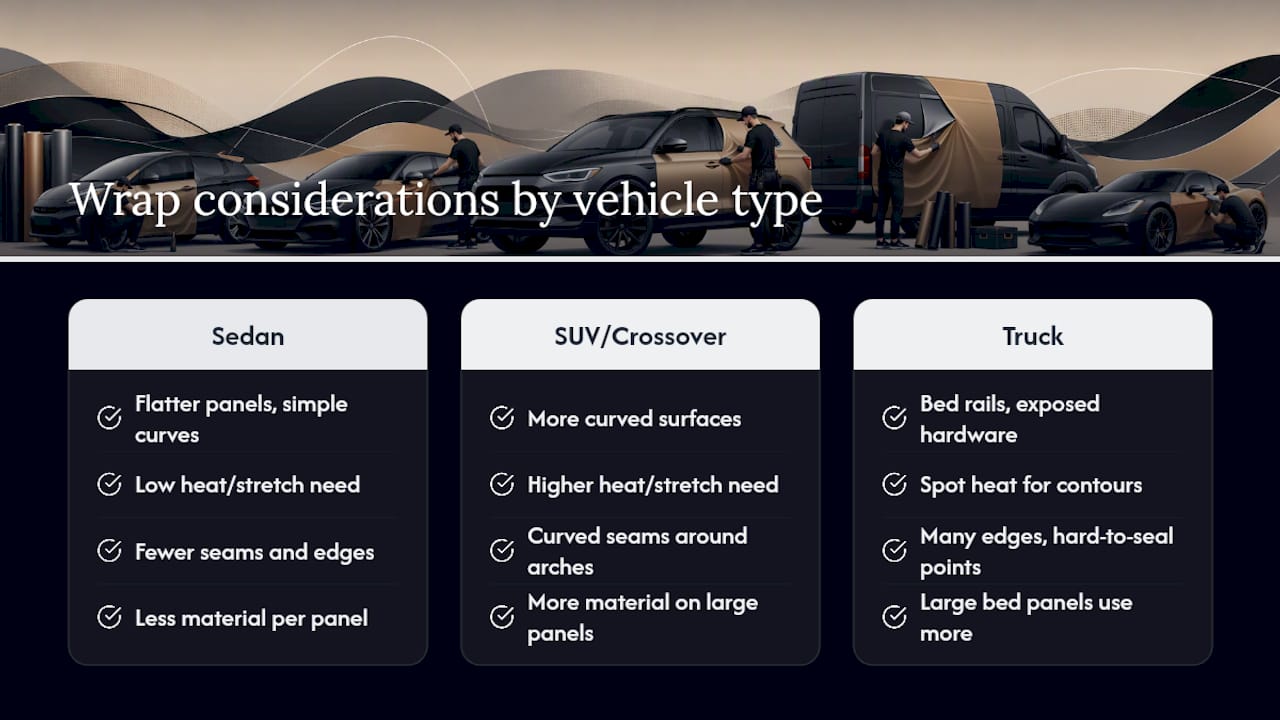
Body style changes what an installer has to plan for, even though the core lease rules stay the same across every vehicle type. Sedans generally offer the most straightforward install: flatter panels, fewer compound curves, and predictable seam placement around doors and the trunk lid. Removal risk on a sedan is usually lower simply because there’s less complex geometry for the vinyl to stretch around.
SUVs and crossovers introduce more curved surfaces, particularly around wheel arches, mirrors, and roof rails. Those curves need more heat during install to conform properly, and more heat means more attention needed on removal to avoid stressing the clearcoat underneath. Larger flat panels like SUV doors and liftgates also mean more material per panel, which raises both install and removal cost.
Trucks bring their own quirks. Bed rails, tonneau covers, and exposed hardware create more edges where vinyl can lift prematurely if it’s not sealed correctly at install. Pickup beds also see more abrasion from cargo, so a wrap on a truck bed panel faces more wear-and-tear risk than the same film on a sedan’s quarter panel.
Model-specific considerations matter too. Vehicles with unusual factory finishes, matte paint, satin trims, or a two-tone factory scheme need an installer who’s dealt with that exact surface before, since wrapping over or around factory matte finishes requires different surface prep than glossy paint. If your leased vehicle has any factory-applied specialty finish, mention it during your installer consultation before scheduling.
Preparing the Surface Before Wrapping
Surface prep decides whether a wrap lasts cleanly for the life of your lease or starts lifting at the edges within months. Skipping steps here is the fastest way to end up with adhesion failures that create their own paint risk during removal.
A proper prep sequence looks like this:
- Deep clean first. A full wash removes road grime, but a clay bar treatment pulls out embedded contaminants that a wash alone leaves behind.
- Degrease every panel. Isopropyl alcohol wipe-downs strip wax, oils, and silicone residue that prevents vinyl adhesive from bonding fully.
- Address existing damage. Chips, scratches, or dents should get fixed before wrapping, since vinyl will highlight rather than hide surface irregularities.
- Remove or mask trim and emblems. Anything that can be pulled should be, for a cleaner wrap line; anything that can’t gets carefully masked.
- Control the environment. Installation needs stable temperature and low dust, which is why a climate-controlled bay outperforms a driveway install every time.
Rushing prep to save a day or two of labor is the single most common cause of early edge lift, and edge lift is exactly the kind of cosmetic flaw a lease inspector will flag.
Legal Considerations for Modifying a Leased Vehicle
The legal question with wraps splits into two separate issues: what your lease contract allows, and what your state’s vehicle laws allow. They’re not the same thing, and conflating them causes confusion.
Your lease is a private contract, and its alteration clause governs what counts as an approved change versus a fee-triggering modification. Most agreements expect the vehicle returned in original condition unless you’ve secured written approval for a reversible change like a wrap. This is a contractual matter between you and the leasing company, not a state law question.
Separately, some states regulate reflective, mirrored, or unusually bright colors on public roads, along with restrictions on window tint darkness that can overlap with wrap projects involving window graphics. These rules vary by state and apply to every driver, leased or not. Before choosing a highly reflective chrome or mirror-finish wrap, check your state’s vehicle equipment regulations rather than assuming any color is fair game.
The practical takeaway: get lessor approval for the contract side, and check your state’s equipment rules for the legal side. Handling only one of the two still leaves you exposed.
Choosing Colors and Finishes That Won’t Raise Flags
Some wrap choices draw scrutiny at turn-in faster than others, and color and finish are the two biggest variables you control. A dramatic color change, like going from factory silver to matte black, is visually obvious and more likely to prompt questions from a lessor even when it’s fully reversible and approved.
Subtler choices tend to create fewer conversations. A wrap in a factory-adjacent color, or a finish that reads as a close match to the original paint, draws less attention and rarely raises a second look during a routine drop-off. Satin and gloss finishes in neutral tones also tend to photograph and inspect more predictably than chrome or color-shift films, which can look inconsistent under different lighting during an inspection.
Partial wraps and accent graphics are worth considering if a full color change feels like more commitment than you want on a leased vehicle. Partial wraps are a lease-friendly, lower-cost alternative when a full wrap’s price tag or removal timeline gives you pause, and they carry less surface area to inspect at turn-in.
None of this changes the paperwork requirement. Even a subtle, factory-adjacent wrap still needs written lessor approval, since the goal isn’t to sneak a wrap past anyone. It’s to make the return process as uneventful as possible.
Handling Damage Found During Wrap Removal
Sometimes removal reveals a problem that wasn’t visible when the wrap went on. A small paint chip under a mirror mount, a faint scratch near a door handle, or minor clearcoat dulling can surface once the vinyl comes off. How you handle it in the days after removal matters as much as the discovery itself.
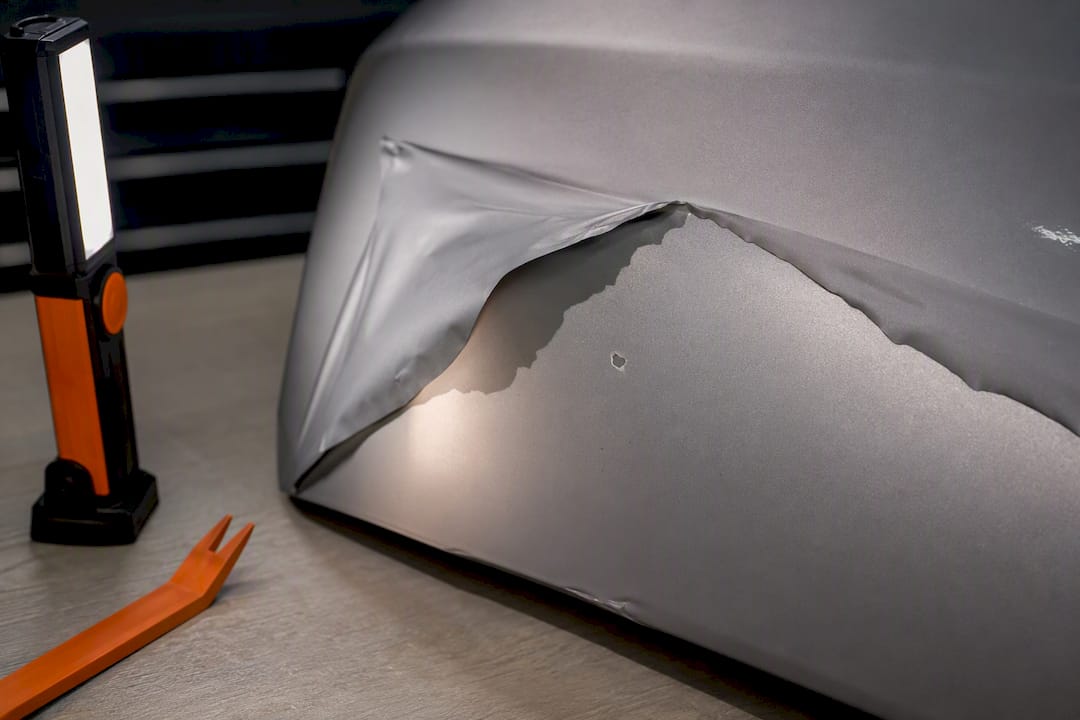
Start with your pre-install photos and inspection report. If the damage was already present and documented before the wrap went on, you have a clear record showing it isn’t wrap-related. That documentation is the difference between a five-minute conversation and a disputed charge.
If the damage genuinely happened during install or removal, address it before the lease inspection rather than hoping it goes unnoticed. A reputable installer will often cover minor touch-up costs under their workmanship warranty, especially if you chose a shop that documents its process the way this article recommends.
When you sit down with the leasing company at turn-in, lead with your paperwork rather than an apology. Present the installer’s removal sign-off and your photo timeline, and let the leasing agent see that the condition matches what was documented at install. Most lease-end disputes get resolved fastest when the paperwork does the talking instead of a back-and-forth argument over what the car looked like months earlier.
What Actually Protects You When You Wrap a Leased Car
The conventional advice on this topic treats “can I wrap a leased car” as a yes-or-no legal question. It isn’t. It’s a documentation question, and most guides bury that fact under generic reassurances about reversibility.
Here’s what the evidence actually supports: the wrap itself is rarely the problem. Paint condition and paperwork are. A wrap applied over failing clearcoat, removed without professional care, or installed without written lessor approval creates exactly the kind of dispute lessees fear, regardless of how good the film looked for two years.
Prioritize in this order: get written approval first, get a documented paint inspection second, and only then start picking colors. Buyers obsess over finish and color choice, which matters far less than most people assume, while skipping the inspection report that actually protects them at turn-in. A shop that offers a removal package as part of the original quote, not as an upsell after installation, is signaling that it understands lease returns as well as it understands vinyl.
— NJ Vinyl Wrapz
Get a Lease-Check Consultation Before You Wrap
NJ Vinyl Wrapz builds the lease paperwork into the process instead of treating it as an afterthought, which is where most wrap-and-lease headaches start. A consultation covers your lease’s alteration clause, a documented pre-install paint inspection, and a removal plan scheduled from day one, not scrambled together weeks before turn-in.
The removal package works the same way a maintenance plan does: it’s booked upfront, priced clearly, and scheduled around your actual lease-end date instead of left to chance. That structure is why lessees consistently prefer a planned removal over a last-minute DIY attempt with a heat gun in the driveway. If you’re weighing a full wrap versus a partial wrap or accent graphics for a leased vehicle, that consultation is the right place to compare cost, coverage, and removal complexity before committing.
Ready to see what a lease-safe wrap looks like on your vehicle? Request a full vehicle wrap quote and ask specifically for the lease-return removal package during your consultation.
Sources
- Can you customize a leased car? | Chase
- Can You Wrap a Leased Vehicle? | Wraptor blog
- Can You Wrap a Leased Vehicle? (What Dealers Don’t Tell You) | ProWraps
- Can You Wrap a Leased Car? Yes — Here’s How to Do It Right | TunedRides
- Can You Wrap a Leased Car? Essential Guide | The Wrap Map Blog
FAQ
Will My Insurance Go Up If I Wrap My Car?
A wrap alone rarely raises premiums, but you should still notify your insurer since wraps are commonly treated as a declared cosmetic modification that can affect how a claim gets processed if it’s not on file.
What Is the 1.5 Rule When Leasing a Car?
This is a budgeting guideline some buyers use, suggesting your monthly lease payment shouldn’t exceed 1.5% of the vehicle’s MSRP; it isn’t a wrap-specific or legal rule, and it has no bearing on modification approval.
What Modifications Can You Make to a Leased Vehicle?
Reversible cosmetic changes like vinyl wraps, window tint within your state’s legal limit, and removable accessories are generally acceptable with written lessor approval, while permanent changes such as body kits, drilled panels, or engine modifications typically are not.
What Is the $3,000 Rule for Buying Cars?
This refers to a rule of thumb some lease-end buyers use, comparing whether the lease’s residual buyout price is close to the car’s market value to decide if buying out the lease makes financial sense; it’s unrelated to wrap approval or lease modification policy.
Do I Need Professional Removal, or Can I Remove a Wrap Myself?
Professional removal is strongly recommended for leased vehicles because DIY removal is where most paint damage happens, and a botched removal can trigger the exact excess wear fees a wrap was supposed to help you avoid.