

If your trailer is 80 inches wide or more and carries a GVWR over 10,000 pounds, federal law requires DOT-compliant conspicuity tape, full stop. The controlling rules live in 49 CFR 393.11 and FMVSS 108, and they’ve applied to trailers built on or after December 1, 1993, along with certain truck tractors manufactured after 1996. Miss the mark on placement or coverage, and you’re looking at a roadside citation.
TL;DR:
- Only trailers 80 inches or wider with a GVWR over 10,000 pounds built after December 1, 1993, require DOT-compliant conspicuity tape, with some exceptions.
- Proper placement involves covering at least 50% of each side’s length, installing a full-width rear strip, and white corner strips at heights between 15 and 60 inches.
- Tape must be DOT-C2 grade, 50 mm wide, with red and white segments in 12-inch intervals, and correctly applied to clean, preheated surfaces.
- Inspection failures typically stem from poor installation, unprepared surfaces, or lack of proper documentation, not from the absence of tape.
- Regular checks for peeling, fading, or cracking are necessary, and old tape should be fully replaced to maintain compliance during routine DOT inspections.
Table of Contents
- What Do the Federal DOT Conspicuity Tape Requirements Actually Say?
- Does Your Trailer Actually Need Conspicuity Tape?
- Where Exactly Does Conspicuity Tape Go?
- What Grade of Tape Meets DOT Requirements?
- How Should You Install Conspicuity Tape the Right Way?
- What Do DOT Inspectors Check for Conspicuity Compliance?
- How Often Should You Inspect and Replace Conspicuity Tape?
- The Shop-Floor Reality Behind Conspicuity Compliance
- Get a Compliant Conspicuity Install Without the Guesswork
- Where to Verify These Requirements Yourself
- Sources
- FAQ
What Do the Federal DOT Conspicuity Tape Requirements Actually Say?
Two regulations do the heavy lifting here. 49 CFR 393.11 sets the placement and coverage rules for retroreflective material on trailers and certain tractors, while FMVSS 108 (49 CFR 571.108), specifically section S8.2, governs how the tape itself must be manufactured, marked, and rated photometrically. Together they cover applicability, exemptions, and the retrofit language that determines whether an older trailer needs to be brought up to code.
The rules don’t apply to every trailer on the road. Certain low-visibility-risk trailers, like some low-profile chassis and specialty units, fall outside the mandate, and the exact carve-outs are spelled out in the regulatory text itself rather than in any summary. NHTSA’s own crash research is the reasoning behind the rule: better nighttime visibility on large trailers measurably reduces certain crash types, which is why enforcement treats this as a safety issue, not paperwork.
The core mandated elements break down to:
- Side coverage of at least 50% of the trailer’s overall length
- A full-width horizontal strip across the rear
- Two 12-inch white strips at the upper rear corners
- Mounting height between 15 and 60 inches above the road surface
Does Your Trailer Actually Need Conspicuity Tape?
Run through this before you order material or schedule an install:
- Measure overall width. If it’s 80 inches (2,032 mm) or more, the rule applies.
- Check GVWR. Anything over 10,000 pounds triggers the requirement.
- Confirm the manufacture date. Trailers built on or after December 1, 1993 fall under the mandate; certain truck tractors are covered starting July 1, 1997.
- Identify the trailer type. Standard van, reefer, flatbed, and container chassis trailers are covered. Some office/living trailers and specific low-profile units have narrower applicability.
- Look for retrofit gaps. Older units still in service that were never tagged need the material added regardless of when they were purchased.
Container chassis and platform trailers often get overlooked because the frame rails obscure part of the surface. That doesn’t exempt them. If your fleet is running a mix of vintage and new trailers, this is the checklist to run at every annual DOT inspection cycle, not just at purchase.
Where Exactly Does Conspicuity Tape Go?
Placement is where most fleets actually fail inspection, not the presence of tape itself. The regulation is specific down to the inch.
- Side strips: Cover at least 50% of the overall trailer length on each side, positioned as close to horizontal as the trailer structure allows.
- Rear strip: Run a horizontal strip across the full width of the rear, marking the outline of the trailer’s shape.
- Upper corners: Apply two white strips, each 12 inches (300 mm) long, at the upper rear corners on both the vertical and horizontal surfaces.
- Height band: Keep the strip centerline between 15 and 60 inches (375 to 1,525 mm) above the road surface, measured with the trailer at curb weight, unladen.
- Lamp clearance: Keep tape roughly 3 inches (75 mm) from lamp lenses so light output isn’t blocked.
Pro Tip: Snap chalk lines along the full side before you cut a single piece of tape. Guessing strip position by eye is how fleets end up with crooked runs that fail a visual inspection even when the coverage percentage is technically correct.
NHTSA has confirmed that obscured sections still count toward the trailer’s overall length, meaning you have to plan strip placement around obstructions, not just skip them and hope the remaining exposed surface clears 50%.
What Grade of Tape Meets DOT Requirements?
DOT-C2 is the baseline that satisfies the federal mandate, and it’s defined by width, not brightness. A 50 mm (2-inch) wide strip is the minimum acceptable size under FMVSS 108. DOT-C3 steps up to 75 mm and DOT-C4 to 100 mm, but wider isn’t automatically “better” reflectivity. It’s simply a different width classification, and C2 is fully compliant on its own for standard trailer applications.
The tape has to alternate red and white in equal segments, typically 12-inch increments, running the length of each strip. A few things to verify before you buy a roll:
- Segment length and color balance match the alternating pattern specified in FMVSS 108
- The manufacturer’s datasheet cites DOT-C2 (or higher) certification explicitly
- Photometric performance references Table XVI-c compliance, not just a generic “reflective” label
- The roll carries a visible DOT marking per S6.5, not an unmarked generic reflective product
Buying unmarked reflective tape because it looks similar under a flashlight is a common and expensive mistake. If the roll doesn’t carry a DOT-C2 marking, it won’t hold up during an inspection, no matter how bright it looks in your shop.
How Should You Install Conspicuity Tape the Right Way?
Getting the tape on straight is one problem. Getting it to stay on through a New Jersey winter is another. Here’s the sequence that actually holds up:
- Clean to bare surface. Degrease down to metal or gel coat. Any road film left behind is the number one reason tape peels within 90 days.
- Mark your lines. Chalk the side strip boundaries and rear placement before peeling any backing.
- Apply within the temperature window. 3M recommends roughly 50°F to 100°F for application; going colder risks incomplete adhesion.
- Peel and roll in sections. Don’t pull the full backing at once. Work in 2 to 3 foot sections, pressing with a hard roller as you go.
- Work around rivets and seams. Where a continuous strip won’t sit flat, split it into two narrower strips separated by no more than an inch, maintaining a continuous retroreflective surface.
- Check adhesion and visibility. Press-test the edges after rolling, then confirm the strips read clearly under headlights at night.
Cold-weather installs need extra prep. Pre-heat the substrate with a heat gun before rolling, and keep your tape rolls in a heated area beforehand rather than pulling them straight from a cold trailer. Skipping that step is a shop-standard cause of early peeling on winter installs.
Pro Tip: Photograph every completed side and both upper corners before the trailer leaves the bay. It takes thirty seconds and gives you documentation if an inspector questions coverage months later.
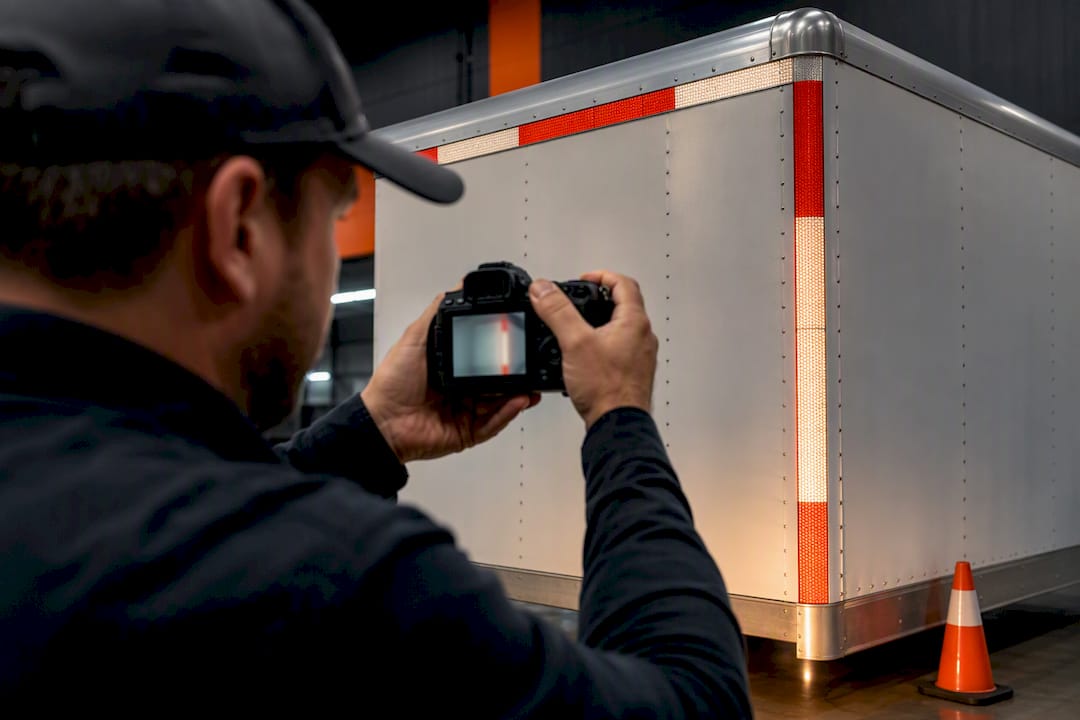
What Do DOT Inspectors Check for Conspicuity Compliance?
Inspectors zero in on a handful of spots fast: the rear lower strip, the upper corner white strips, and general side coverage. Those are the quickest visual indicators of compliance, which is exactly why they’re the most common failure points.
- Rear strip present, continuous, and reflective (not faded or road-grimed to the point of ineffectiveness)
- Both upper corner strips intact and visible from a normal approach angle
- Side coverage at or above the 50% threshold across the full trailer length
- No sections obscured by decals, mud, or damage severe enough to block reflectivity
- Mounting height within the 15 to 60 inch band
Peeling corners, faded segments, and missing rear strips generate the bulk of citations FMCSA documents in its installation and enforcement guidance. Keep dated photos of the completed install, the purchase invoice showing DOT-C2 certification, and the manufacturer’s datasheet on file. That paper trail resolves most disputes on the spot instead of turning into a drawn-out compliance headache.
How Often Should You Inspect and Replace Conspicuity Tape?
Reflective sheeting doesn’t fail all at once. Watch for these signs during routine pre-trip checks:
- Peeling edges or lifted corners, especially near rivets and seams
- Crazing or cracking across the surface, usually from UV exposure over several seasons
- Dulled reflectivity that doesn’t pop under headlights the way it did when new
- Chalking or fading in the red segments before the white ones
Check conspicuity tape at every scheduled DOT inspection, and add a quick visual pass to pre-trip routines for older trailers. When you do replace it, strip the old material fully rather than layering new tape over degraded adhesive. That’s the fastest route back to a compliant, durable install.
The Shop-Floor Reality Behind Conspicuity Compliance
Most fleets don’t fail DOT conspicuity checks because they skipped the tape. They fail because the install was rushed, the surface wasn’t prepped right, or nobody documented the job. NJ Vinyl Wrapz has spent over a decade installing reflective and branding material on commercial fleets across New Jersey, Pennsylvania, New York, and Delaware, working with 3M and Avery materials in climate-controlled bays where temperature and surface prep aren’t a guessing game. Our shop checklist mirrors the regulation itself: measure first, chalk lines before cutting tape, clean to bare surface, and photograph every completed side before the trailer rolls out.
— NJ Vinyl Wrapz
Get a Compliant Conspicuity Install Without the Guesswork
Ordering tape online and hoping it lines up is one route. Handing the job to a shop that measures, documents, and installs to spec is the faster one, especially when a failed inspection means a truck sitting idle instead of running routes. NJ Vinyl Wrapz installs DOT-C2 conspicuity tape on fleet trailers across New Jersey, Pennsylvania, New York, and Delaware using premium 3M and Avery materials, with every job documented by photos and datasheets so you have proof of compliance on hand at any roadside stop.

A professional install means correct height bands, full side coverage without guesswork around rivets and axles, and a finished job that holds up through winter without peeling by spring. If you’re running a mixed fleet with a few units that were never retrofitted, or you just want conspicuity work bundled with your next branding project, get a quote through our full vehicle wrap services page. We’ll also walk you through how conspicuity placement interacts with fleet branding if you’re wrapping trailers, since strip and design layout need to be planned together, not fought over after the fact. Reach out to schedule a shop visit and get your fleet’s conspicuity compliance handled in one appointment.
Where to Verify These Requirements Yourself
The regulations and manufacturer guidance behind this article are public and worth bookmarking: 49 CFR 393.11 for placement rules, FMVSS 108 / 49 CFR 571.108 for tape specifications, and FMCSA’s installation guidance for enforcement context. For a broader maintenance routine that folds conspicuity checks into your regular schedule, Premier Fleet Repair’s trailer maintenance checklist is a solid companion reference.
Sources
- 49 CFR 393.11 — Position and conspicuity of lighting and retroreflective material
- 49 CFR 571.108 — FMVSS No. 108; Lamps, reflective devices, and associated equipment
- FMCSA — Installation of retroreflective tape or reflex reflectors
FAQ
What are the requirements for reflective tape on semi-trucks?
Trailers 80 inches or wider with a GVWR over 10,000 pounds need DOT-C2 (or higher) tape covering at least 50% of each side, a full-width rear strip, and two white strips at the upper rear corners, each about 12 inches (300 mm) long, per 49 CFR 393.11.
Is conspicuity tape required on a straight truck?
Straight trucks themselves aren’t covered by the trailer conspicuity mandate, but certain truck tractors manufactured after July 1, 1997 do have their own retroreflective requirements under FMVSS 108.
What is DOT-C2 reflective tape?
DOT-C2 is a federally recognized width classification, minimum 50 mm (2 inches), for retroreflective sheeting that meets the photometric and marking standards in FMVSS 108. It’s the baseline grade that satisfies the conspicuity mandate, not a brightness rating.
Does DOT require reflective tape on mud flaps?
No. The federal mandate covers side, rear, and upper corner placement on the trailer body itself. Mud flaps aren’t a required mounting location, though areas obscured behind them still count toward your overall coverage percentage.