
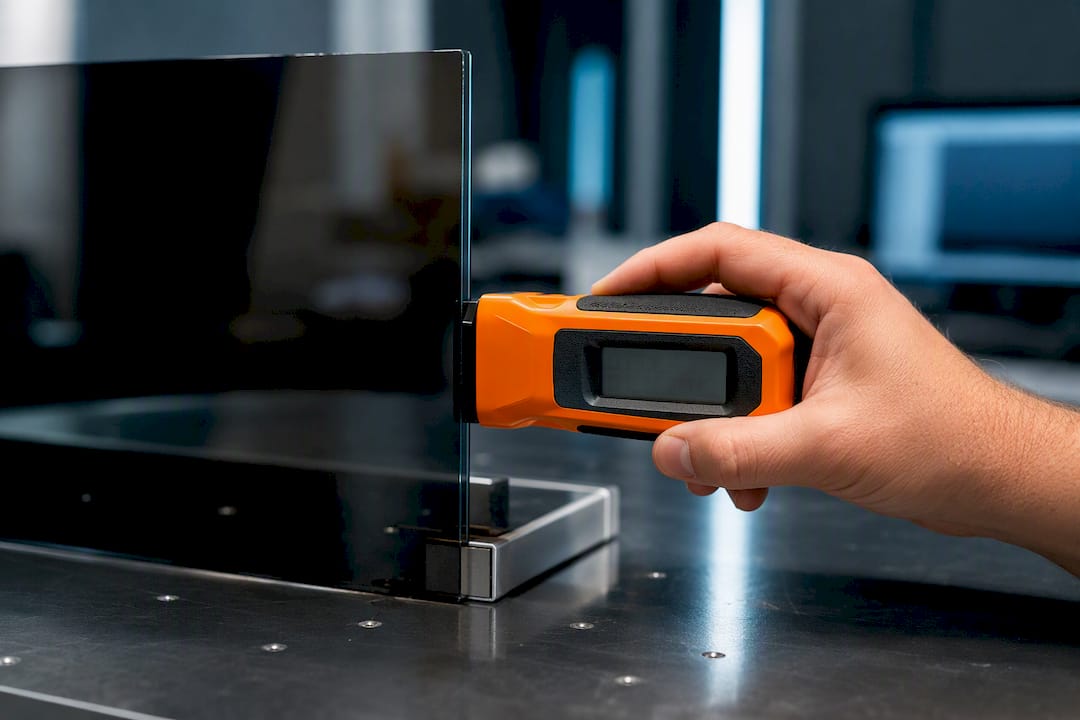
A tint percentage is the visible light transmission, or VLT: the share of visible light that gets through the glass and film together. Lower numbers mean darker glass, so a 5% film blocks far more light than a 50% film. VLT is not the same as heat or UV rejection, and legal limits change by state and by window, so the number on the box only tells part of the story.
TL;DR:
- Higher VLT percentages mean more light passes through, with 20% VLT being very dark and 50% VLT being relatively light, affecting visibility and privacy accordingly.
- Heat rejection depends more on film technology and TSER ratings than on darkness, making lighter ceramic films often more effective than darker dyed films.
- Legal tint limits vary by window and state, so verifying and obtaining net VLT measurements in writing is essential for compliance.
- Proper measurement with calibrated meters can vary within a few percentage points, and installers should provide proof of net VLT before leaving the shop.
Table of Contents
- What Tint Percentages Explained Actually Measure (VLT Basics)
- Darkness Isn’t the Whole Story: TSER, UV, and Film Type
- Why Your Installed Tint Reads Darker Than the Film’s Rating
- Common VLT Levels and What They Look Like on the Road
- How Installers and Inspectors Actually Test Your Tint
- Legal Limits Depend on the Window, Not Just the State
- Picking the Right Percentage: A Practical Checklist
- Why NJ Vinyl Wrapz’s Installation Experience Backs This Guide
- A Straight Answer for Anyone Still Unsure How Dark to Go
- Get a Measured, Compliant Tint Install Done Right
- Where to Check Tint Laws and Measurement Standards
- Sources
- FAQ
What Tint Percentages Explained Actually Measure (VLT Basics)
Visible light transmission measures the slice of the light spectrum your eyes actually use, roughly 380 to 700 nanometers, and reports it as a percentage of what makes it through the glass-and-film combination.
Shops and inspectors check this with a tint meter, essentially a small photometer that shines a calibrated light through the glass and reads how much comes out the other side. It is a direct physical measurement, not a guess based on how dark the glass looks.
The confusing part for most first-time buyers is the inverse relationship between the number and the darkness:
- Higher percentage = more light gets through = lighter tint
- Lower percentage = less light gets through = darker tint
- A common mix-up is assuming 35% is darker than 20%, when it’s actually the other way around
Once that logic clicks, reading a tint chart or a shop invoice gets a lot easier.
Darkness Isn’t the Whole Story: TSER, UV, and Film Type
VLT tells you how dark a window looks. It says almost nothing about how much heat comes through. That’s measured separately as total solar energy rejection, or TSER, which accounts for infrared and UV energy on top of visible light.
This is where film technology matters more than most buyers realize. A premium ceramic film at 50% VLT can reject more heat than a cheap dyed film at 20% VLT, because ceramic particles scatter infrared energy without relying on dark pigment to do the work. Dyed film mostly just darkens the glass and fades over time; ceramic film manages heat and UV while staying lighter and more stable.
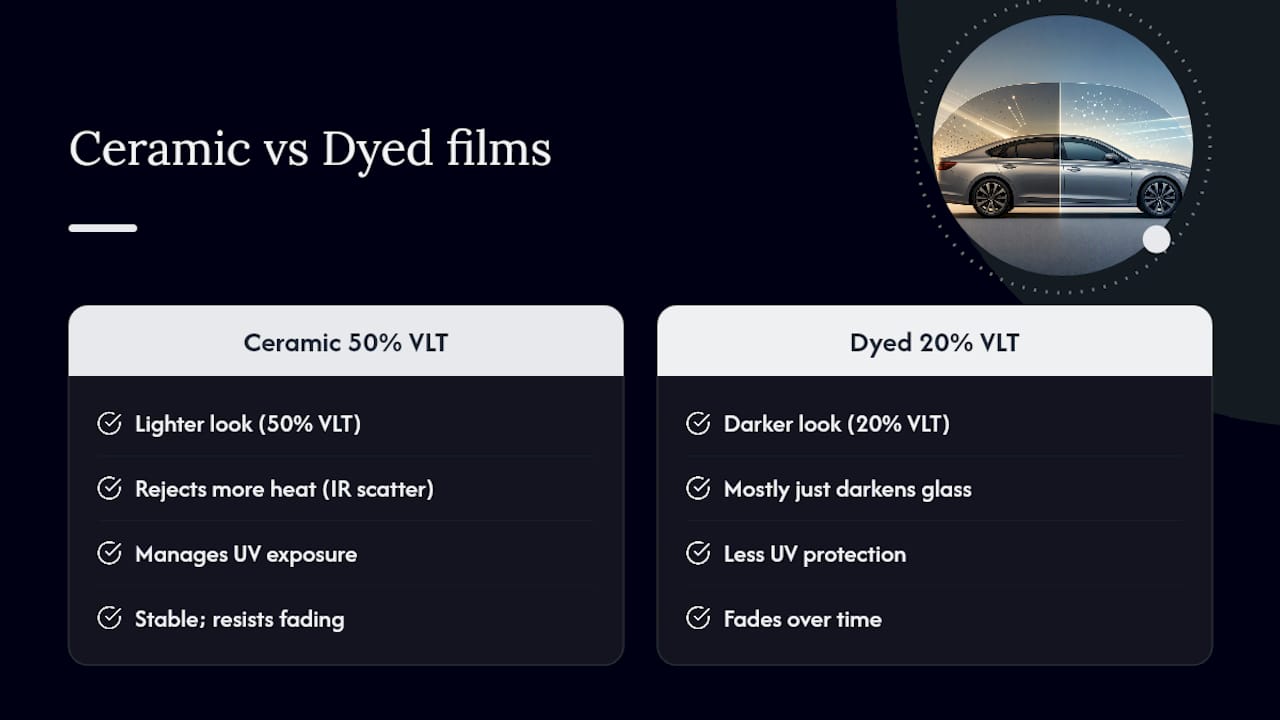
The practical move is to match the technology to the actual problem. If the goal is cooler interiors and less sun glare rather than a darker look, a lighter ceramic film often beats a darker dyed one on every metric that matters.
Pro Tip: Ask your installer for the TSER rating alongside the VLT percentage. Two films with the same VLT can perform completely differently in the heat department.
Why Your Installed Tint Reads Darker Than the Film’s Rating
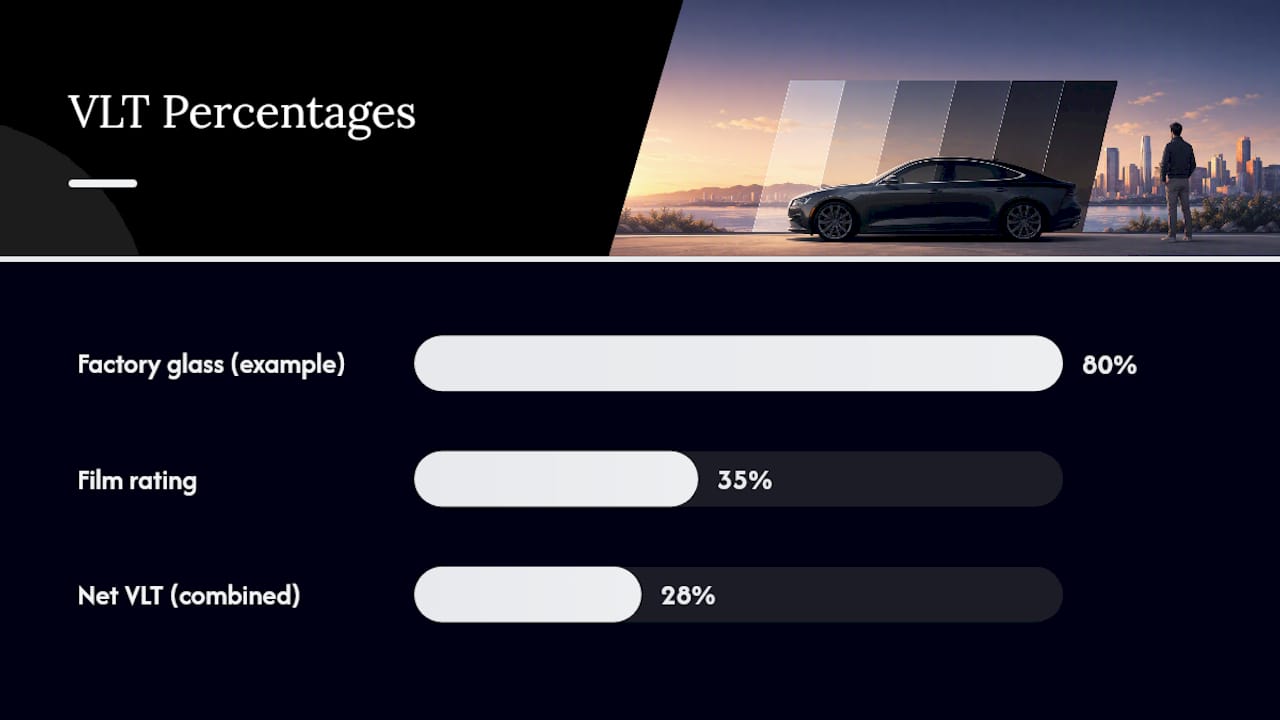
Here’s the part that catches people off guard: factory glass is not perfectly clear. Most automotive glass already sits around 70% to 80% VLT before any film goes on it. It multiplies against whatever the glass already lets through.
The math looks like this:
- Start with the glass’s factory VLT (say, 80%)
- Multiply it by the film’s rated VLT (say, 35%)
- The result is your net VLT: 0.80 × 0.35 = 0.28, or about 28%
A film labeled at 35% VLT installed over factory glass will often register a lower net VLT percentage on a meter due to the multiplication effect of the glass’s own VLT, which is why legal compliance depends on the combined value rather than the film’s rated value alone.
Common VLT Levels and What They Look Like on the Road
Reading a spec sheet is one thing. Knowing what 20% actually looks like through your rearview mirror is another.
- 5% VLT: Near-opaque, often called the “limo” look. Common on rear windows for privacy, rarely street legal on front windows anywhere.
- 20% VLT: Dark, hard to see occupants from outside, popular on SUVs and trucks for a stealth appearance.
- 35% VLT: A middle-ground shade that still cuts glare and heat noticeably while staying easier to see through at night.
- 50% VLT: Light tint, mostly for glare and UV reduction, minimal visual darkening.
- 70% VLT: Barely noticeable, sometimes just a factory-tinted windshield strip or a light UV film.
How Installers and Inspectors Actually Test Your Tint
A tint meter takes the guesswork out of compliance checks, and the type of meter matters more than people expect.
- Horseshoe meters clamp around the edge of a window and are the most common tool for roll-down glass, but they can’t measure fixed panes like windshields or many rear windows.
- Two-piece (magnetic probe) meters split into a light source and a sensor placed on opposite sides of the glass, which lets them measure fixed glass that horseshoe meters simply can’t reach.
Good meters are generally accurate within about ±1 to 2 percentage points when properly calibrated, which is tight enough to matter at the margins of a legal limit. If two readings on the same window disagree by more than that, ask the installer to re-test and share the meter model and calibration date. A shop with nothing to hide will hand that over without hesitation.
Legal Limits Depend on the Window, Not Just the State
Tint law is not one flat number. Nearly every state sets different limits for the windshield, front side windows, rear side windows, and the rear window, and those limits can vary sharply from one state to the next.
A lot of states land somewhere around 35% VLT for front side windows as a compromise between privacy and driver visibility, but plenty of states allow darker rear windows, and some allow no tint at all on the windshield above the manufacturer’s strip. New Jersey, for example, has its own specific breakdown worth checking directly against the state’s tint rules before you book an install.
Before you commit to a percentage:
- Check your own state’s DMV or motor vehicle commission page for the current limits by window position.
- Ask your installer to confirm net VLT after installation, not just the film’s rated percentage.
- Keep the paperwork from that measurement in your glovebox in case an officer asks.
- If you have a medical condition requiring darker tint, look into your state’s exemption process before installation, not after.
Picking the Right Percentage: A Practical Checklist
Choosing a tint percentage is really about ranking your priorities and letting the legal floor set your boundary.
- Start with your state’s legal limit for each window position, since that sets the darkest option available to you.
- Pick film technology based on your actual problem. Chasing heat control means prioritizing TSER and ceramic construction, not just picking the lowest VLT number.
- Factor in night driving. If you drive a lot after dark, staying at 35% or higher on front windows keeps visibility more comfortable.
- Ask for a net-VLT reading in writing before you leave the shop, so you have proof of compliance if you’re ever stopped.
Pro Tip: If you’re torn between two percentages, go with the lighter one on front windows. You can always add more privacy film to the rear later, but you can’t easily undo a citation.
Why NJ Vinyl Wrapz’s Installation Experience Backs This Guide
Some tint, wrap, and paint protection film installers have over 10 years experience and may use premium materials inside climate-controlled facilities to ensure consistent results. That kind of repetition is where the net-VLT math above stops being theory and starts being a daily checklist. Before you drive off from any shop, ask to see the net-VLT measurement in writing and get the warranty terms in hand.
A Straight Answer for Anyone Still Unsure How Dark to Go
Compliance and film quality beat chasing the darkest number every time. If you’re stuck deciding, pick the legal limit for your state and a ceramic film built for heat, not the darkest tint on the price list.
— NJ Vinyl Wrapz
Get a Measured, Compliant Tint Install Done Right
Some tint shops provide a written net-VLT measurement handed over before you leave, so you know exactly what passed and what’s on your car.
That matters because, as covered above, a film’s rated percentage and the meter’s actual reading are rarely the same number once factory glass gets factored in. Installers may use premium 3M and Avery film inside climate-controlled facilities to keep results consistent across different vehicles. Tint installation can sometimes be combined with other vehicle services like wraps or paint protection film during the same visit. Book an inspection through our window tinting service page and get a straight answer on what percentage actually fits your car and your state’s limits before anything goes on the glass.
Where to Check Tint Laws and Measurement Standards
For a deeper technical breakdown of how VLT is measured and why net VLT drops below the film’s rating, the EngineerSkill.blog guide to VLT measurement covers the physics in more detail than most shop websites bother to. Readers comparing meter types before an install can also review the Instrument Choice breakdown of horseshoe versus two-piece meters for a sense of what accuracy to expect from each design. And for a state-by-state sense of how limits and film technology interact, Green Film USA’s tint law notes are a useful starting point before contacting your own state’s DMV directly.
Sources
- Engineerskill
- How To Test Window Tint Percentage - Instrument Choice (blog)
- Green Film USA — tint laws and film tech notes
FAQ
Is 20% or 35% Tint Darker?
Since VLT measures how much light passes through, the lower number always lets in less light and looks noticeably darker on the glass.
How Dark Can Tint Be Legally on a Car?
It depends entirely on your state and the specific window, since windshields, front sides, rear sides, and rear windows often carry different limits.
Does Darker Tint Always Block More Heat?
Not necessarily. A high-quality ceramic film at a lighter VLT can reject more heat than a cheap dyed film at a darker VLT, since heat rejection depends on film technology and TSER rating, not darkness alone.
Does NJ Vinyl Wrapz Provide Written Proof of Legal Tint Levels?
NJ Vinyl Wrapz measures net VLT after installation and can provide that documentation, giving customers a record that matches their state’s legal requirements. Current pricing and booking details are available on the window tinting service page.