
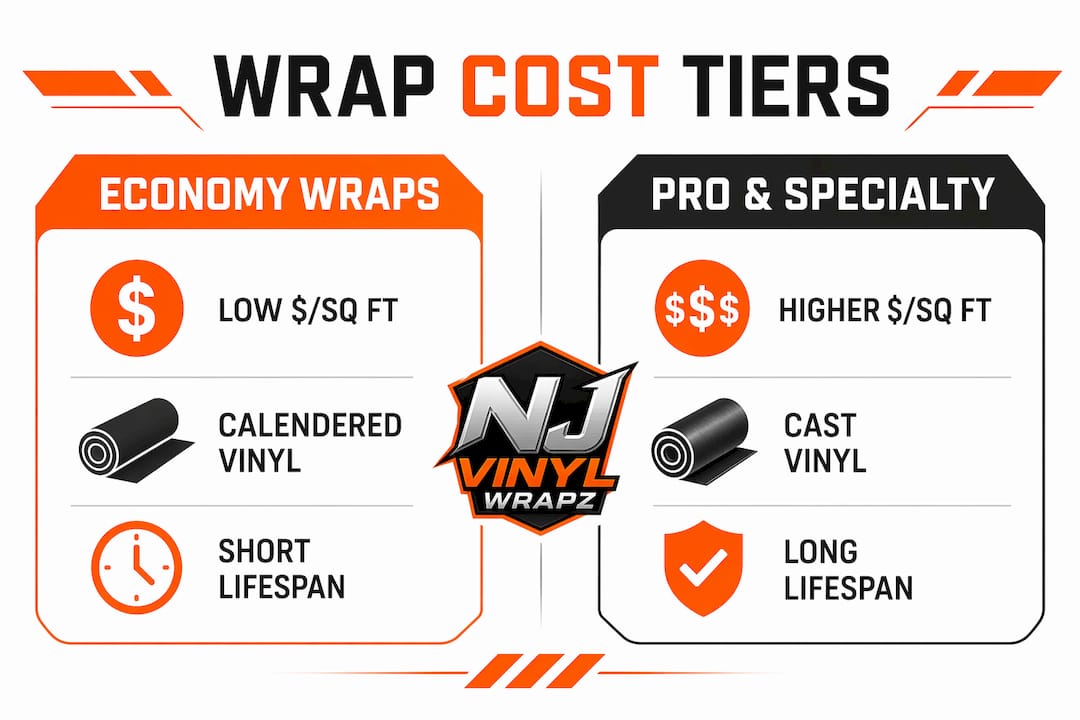
Most professional vehicle wraps run at a moderate to high rate per square foot all-in when you combine materials and labor. Break that down and you’re looking at three rough tiers:
- Economy (cast vinyl, solid colors): $5–$8/sq ft total
- Professional (premium cast, printed graphics): $8–$16/sq ft total
- Specialty (chrome, color-shift, textured films): $16–$30+/sq ft total
The caveat that changes all of this: those numbers assume a relatively flat vehicle. Body complexity — deep recesses, compound curves, aggressive body lines — commonly pushes labor up 20–40%, making flat per-square-foot math optimistic for many vehicles. Material grade, installer certification, and regional labor rates do the rest. A full wrap on a passenger vehicle typically lands between $2,000 and $10,000 depending on those variables. Njvinylwrapz, which has wrapped commercial fleets across New Jersey for over a decade, uses 3M and Avery Dennison materials and prices accordingly.
Table of Contents
- What a per-square-foot price actually includes
- How $/sq ft converts to real money by vehicle type
- Key factors that raise or lower your effective cost
- How per-square-foot pricing compares to other quoting models
- How fleet quotes change the per-vehicle math
- What to give installers to get a reliable quote
- Why installer skill and warranty terms matter more than small price differences
- How Njvinylwrapz structures a professional quote
- Key Takeaways
- The price signal most buyers miss
- Njvinylwrapz wraps New Jersey fleets with line-item pricing
- Useful sources
- FAQ
What a per-square-foot price actually includes
The $/sq ft figure on a quote is rarely one thing. It bundles several cost layers, and knowing what’s inside helps you spot when something’s been left out.
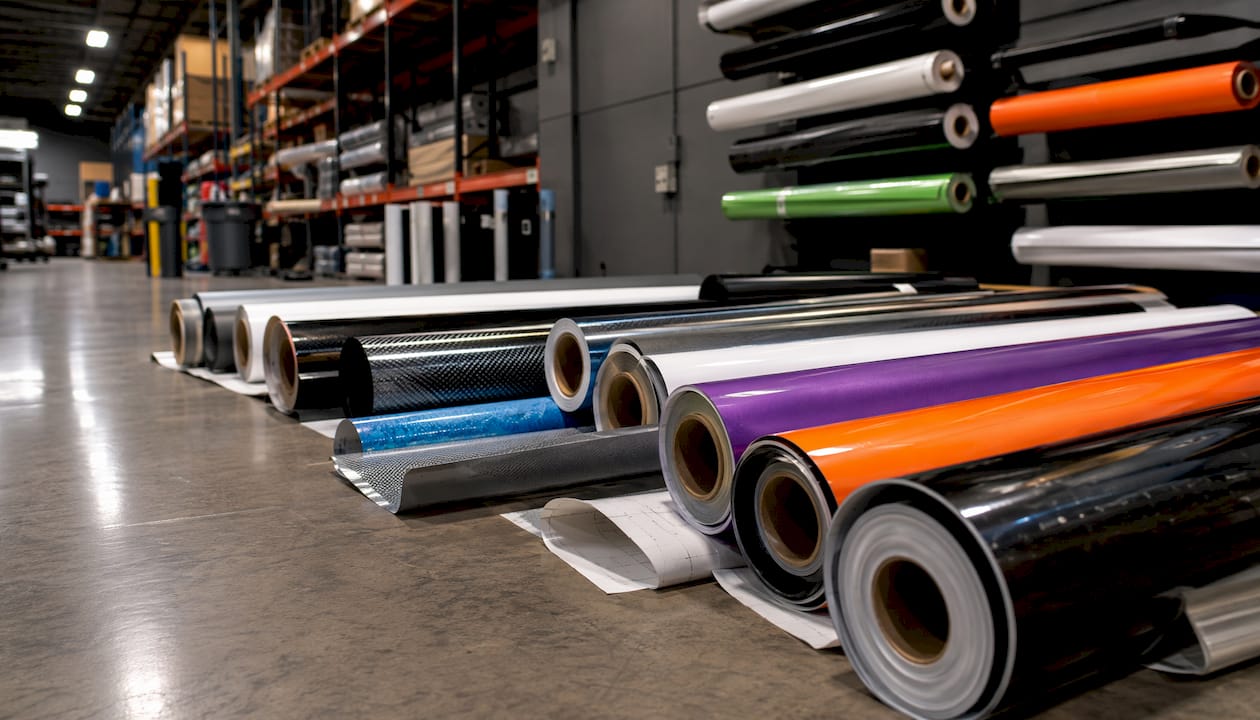
Material cost is the vinyl film itself. Economy cast vinyl runs roughly $1.50–$3/sq ft; premium cast (the grade used by most reputable shops) runs $3–$6/sq ft; specialty films like chrome or color-shift push $6–$12+/sq ft. The grade matters beyond price: premium cast conforms to curves without lifting and typically carries a longer manufacturer warranty.
Printed graphics add another layer. Custom-printed designs — full-color advertising wraps, photographic imagery — commonly start around $5–$15+/sq ft once you factor in wide-format printing, color profiling, and the overlaminate that protects the ink from UV and abrasion. A solid color-change wrap skips the print cost entirely.
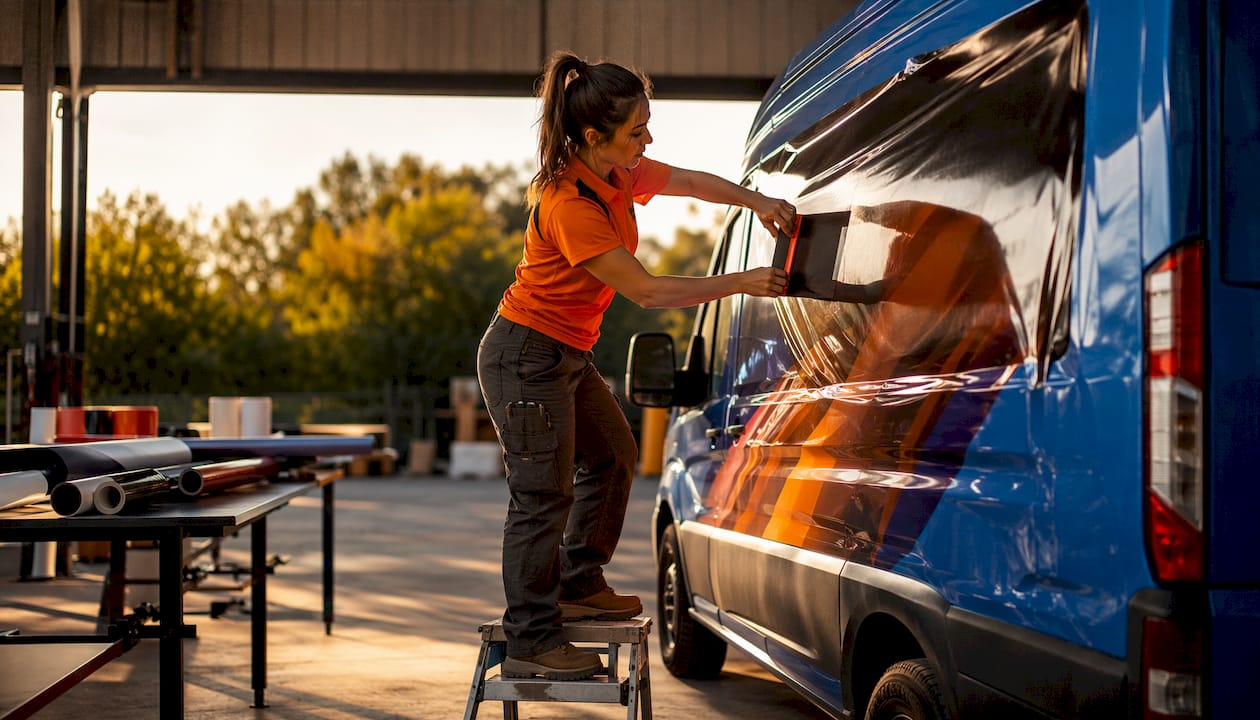
Labor, expressed as a per-square-foot rate, typically runs $3–$8/sq ft or $75–$150 per hour depending on region and vehicle complexity. On a flat cargo van, that labor rate stays near the low end. On a sports car with sculpted panels, it climbs fast.
What’s often excluded from the $/sq ft line:
- Paint correction or dent repair (usually quoted separately)
- Old wrap removal ($2–$5/sq ft is common)
- Window film or graphics
- PPF (paint protection film) upgrades
- Design fees for custom artwork
Waste factor is the line item most buyers never see. Installers add 15–25% to the material order to account for trimming, repositioning on compound curves, and overlap at seams. A vehicle with 200 sq ft of wrappable surface actually consumes 230–250 sq ft of film. That cost gets absorbed into the $/sq ft rate or listed as a separate materials line.
Pro Tip: A quote that looks cheap per square foot often reflects economy-grade calendered vinyl (not cast), skipped prep work, or a shop that hasn’t built the waste factor in — meaning you’ll see it as a surprise add-on later.
How $/sq ft converts to real money by vehicle type
The math only works once you know how much surface you’re actually wrapping. Wrappable area varies significantly by vehicle class:
| Vehicle Type | Approx. Wrappable Area | Economy Total | Pro Total | Specialty Total |
|---|---|---|---|---|
| Compact sedan | 150–200 sq ft | $750–$1,600 | $1,200–$3,200 | $2,400–$6,000+ |
| Mid-size SUV/crossover | 200–250 sq ft | $1,000–$2,000 | $1,600–$4,000 | $3,200–$7,500+ |
| Full-size truck/large SUV | 250–300 sq ft | $1,250–$2,400 | $2,000–$4,800 | $4,000–$9,000+ |
| Cargo van | 300 sq ft | $1,500–$3,200 | $2,400–$6,400 | $4,800–$12,000+ |
Note: These are material + labor estimates only. Add prep, removal, and design fees for a complete budget.
Two worked examples:
A mid-size SUV at 225 sq ft with a pro-grade color-change wrap: 225 sq ft × $10/sq ft all-in = $2,250 base, plus 20% waste factor on materials ($3–$6/sq ft tier) adds roughly $135–$270 in film. Total realistic budget: $2,400–$2,600 before any prep or design work. That aligns with the industry’s common pro band of $2,500–$6,500 for most passenger vehicles.
A cargo van at 350 sq ft with full-color printed graphics at $12/sq ft: 350 × $12 = $4,200, plus waste factor and a $300–$500 design fee puts the realistic total at $4,700–$5,000. Add old-wrap removal if needed and you’re at $5,200–$5,500.
Watch out: Vehicles with aggressive body lines, deep door recesses, or heavy exterior trim can push labor estimates up 20–40% compared with flat-sided vehicles. A pickup truck with sculpted fenders is not the same job as a box truck, even if the square footage is similar.
Key factors that raise or lower your effective cost
Understanding which variables move the price helps you compare quotes fairly and avoid paying for upsells you don’t need.
Primary cost drivers:
- Vehicle size and body complexity: More surface area means more material; complex curves mean more labor hours. This is the single biggest variable.
- Vinyl grade and finish: Stepping from economy cast to premium cast roughly doubles material cost. Specialty finishes (chrome, color-shift, matte metallic) can increase per-square-foot cost dramatically — chrome films alone often push the all-in rate above $20/sq ft.
- Print complexity: A solid color-change wrap is the cheapest print option. Full photographic advertising graphics with multiple colors, gradients, and bleeds cost significantly more per square foot.
- Installer skill and certification: A certified 3M or Avery Dennison installer charges more per hour, but their work lasts longer and comes off cleanly at removal. Installation quality directly determines both wrap lifespan and paint safety.
- Surface prep and paint condition: Oxidized paint, dents, or prior wrap adhesive require correction before installation. Shops either charge for this separately or build it into a higher labor rate.
- Geographic labor rates: A shop in Manhattan charges more per hour than one in rural New Jersey. The material cost is the same; the labor rate isn’t.
Hidden upsell checklist — confirm these in writing before signing:
- Paint correction or clay bar treatment included or extra?
- Old wrap removal: included or billed per sq ft?
- Overlaminate: included in the graphics price?
- Warranty: covers material defects only, or installation too?
- Trim removal (mirrors, door handles): included in labor?
How per-square-foot pricing compares to other quoting models
Shops quote vehicle wraps three ways, and each has real trade-offs.
1. Per-square-foot pricing works well for straightforward color-change wraps and fleet jobs where vehicles are consistent. The math is transparent and easy to compare across shops. The weakness: it doesn’t automatically account for body complexity. A flat $/sq ft rate on a sports car with deep curves will almost always underestimate the actual labor.
2. Hourly pricing is more honest for complex vehicles. If a shop quotes $100/hour and estimates 20 hours for a full wrap, you’re at $2,000 in labor alone before materials. The risk is that estimates can creep if the job takes longer than projected. Always ask for a not-to-exceed cap.
3. Flat per-vehicle pricing is common for fleet programs where the shop has wrapped the same model dozens of times. It’s the cleanest for budgeting because there are no surprises, but it requires the shop to have real experience with that specific vehicle.
Pros and cons at a glance:
- Per sq ft: Easy to compare; can miss complexity costs
- Hourly: Honest for complex jobs; harder to budget without a cap
- Flat per vehicle: Best for fleets; requires shop familiarity with the model
When to insist on a line-item estimate: Any time the all-in quote is a single number with no breakdown, ask for it itemized. Material, labor, prep, waste factor, design, and removal should each be a separate line. A shop that won’t break it down is either hiding margin or doesn’t know their own costs.
How fleet quotes change the per-vehicle math
Scale genuinely changes the economics of vehicle wrap pricing, but not always in the ways business owners expect.
Fleet projects commonly unlock material discounts of 10–20% once a shop orders film in volume. On a premium cast vinyl at $4/sq ft, a 15% discount saves $0.60/sq ft. Across a 10-van fleet at 350 sq ft each, that’s $2,100 in material savings before you touch labor.
Labor efficiency is the bigger lever. A shop that wraps the same cargo van model repeatedly develops a workflow: they know exactly where the seams go, which panels need extra heat, and how long each step takes. That familiarity can cut per-vehicle labor time by 15–25% by the third or fourth unit.
Fixed costs that don’t scale are the trap most fleet buyers miss. Design fees, color proofing, template setup, and shipping for specialty materials are one-time charges. On a single vehicle, a $600 design fee adds $600 to the cost. Spread across 10 vehicles, it’s $60 each. Always ask for these to be listed separately so you can amortize them correctly.
Fleet quoting checklist:
- Provide VINs for every vehicle (shops use these to pull factory body specs)
- Supply high-resolution photos of each vehicle, all four sides
- Share your brand files in vector format (AI or EPS, not JPG)
- Specify expected uptime and whether vehicles can be wrapped in batches
- Ask for a per-vehicle breakdown showing material, labor, and setup separately
Njvinylwrapz works with fleet wrap programs across New Jersey and can structure quotes to show per-vehicle costs clearly, including volume pricing lines when the fleet size qualifies.
What to give installers to get a reliable quote
A vague request gets a vague number. The more specific your RFP, the more accurate the quote — and the less likely you are to see surprise charges at pickup.
Request-for-quote checklist:
- Make, model, year, and trim level
- VIN (allows the shop to pull exact factory body dimensions)
- High-resolution photos: driver side, passenger side, front, rear, and any complex areas (wheel arches, mirrors, spoilers)
- Desired film type and finish (color-change solid, matte, printed graphics, specialty)
- Artwork files if you have them (vector preferred; note the file format and color profile)
- Timeline and any hard deadlines
- Whether old wrap removal is needed
Questions to ask every installer:
- Which brand of film do you use — 3M, Avery Dennison, or something else?
- What waste factor are you assuming, and is it built into the $/sq ft or listed separately?
- Is labor quoted per square foot or hourly? If hourly, what’s the not-to-exceed estimate?
- What prep work is included — clay bar, decontamination, panel wipe-down?
- What does the warranty cover, and for how long?
- What are your post-install care instructions?
Red flags that suggest a quote is too low:
- No mention of film brand or grade
- Single all-in number with no line items
- No waste factor listed
- Warranty is verbal, not written
- Turnaround time is under 24 hours for a full wrap
Pro Tip: Before contacting any shop, take six photos of your vehicle (all four sides plus front and rear) and note the VIN. That alone cuts quote turnaround time significantly and forces the shop to price your actual vehicle, not a generic estimate.
Preparing your vehicle properly before the appointment also affects the final price. Shops that find contaminated paint or adhesive residue at intake often add a prep surcharge. Njvinylwrapz’s guide on vehicle prep before a wrap walks through exactly what to do before you drop off.
Why installer skill and warranty terms matter more than small price differences
A $1/sq ft difference between two quotes sounds small. On a 250 sq ft truck wrap, that’s $250. But the wrong installer can cost you $1,500–$3,000 in paint correction if the wrap lifts prematurely or leaves adhesive damage at removal.
What a professional installation actually involves:
- Surface decontamination: iron fallout remover, clay bar, isopropyl wipe-down
- Panel-by-panel heat-forming to conform film to compound curves without tension
- Edge-tucking at door jambs, wheel arches, and trim lines
- Post-heating to activate the adhesive and lock the film to the surface
- Final inspection under controlled lighting for bubbles, lifting edges, and color consistency
Skipping any of these steps shortens lifespan and increases the chance of paint damage at removal. Certified installers use precision heat-forming and post-heating — buyers should prefer shops that list certified material brands like 3M or Avery Dennison on their estimates.
Typical warranty structures:
| Warranty Type | What It Covers | Typical Duration |
|---|---|---|
| Manufacturer (film) | Material defects, fading, cracking | 3–7 years (varies by film grade) |
| Installation | Lifting edges, bubbles, seam failure | 1–2 years at most shops |
| Combined | Both above, from a certified installer | Up to 5 years at premium shops |
Lifespan by material grade:
- Economy calendered vinyl: 2–3 years outdoors
- Premium cast vinyl: 5–7 years with proper care
- Specialty films (chrome, color-shift): 3–5 years; more sensitive to heat and abrasion
Maintenance extends life significantly. Hand-washing, avoiding high-pressure jets on seams, and keeping the vehicle garaged when possible can add a year or more to a premium wrap. Njvinylwrapz covers the specifics in their guide on protecting vinyl wraps.
Warranty questions to confirm in writing:
- Does the warranty transfer if the vehicle is sold?
- What voids it (pressure washing, certain chemicals, parking outdoors)?
- Who handles a warranty claim — the shop or the film manufacturer?
- Is there a deductible or inspection fee for claims?
How Njvinylwrapz structures a professional quote
Seeing how a real shop turns $/sq ft into a defensible estimate is more useful than any formula. Here’s the workflow Njvinylwrapz uses from intake to handoff.
Installation workflow:
- Intake and measurement: Vehicle arrives, shop measures wrappable surface area and photographs all panels. VIN is cross-referenced against factory specs.
- Material selection: Client selects film grade and finish from 3M or Avery Dennison product lines. Njvinylwrapz stocks both brands and can show physical samples.
- Surface prep: Decontamination wash, clay bar treatment, and panel inspection. Any paint correction needs are flagged before work begins.
- Installation: Performed in a climate-controlled facility to prevent dust contamination and ensure proper adhesive activation. Heat-forming and edge-tucking are standard.
- QA and handoff: Final inspection under controlled lighting. Client walks the vehicle with the installer before pickup.
Example quote line items (illustrative — actual pricing varies by vehicle and finish):
| Line Item | Example Range |
|---|---|
| Surface prep / decontamination | $100–$250 |
| Design / artwork setup | $200–$500 |
| Old wrap removal (if applicable) | $300–$600 |
Njvinylwrapz’s 3M and Avery Dennison partnerships mean clients get manufacturer-backed material warranties alongside the shop’s own installation guarantee. That combination is what separates a defensible quote from a number pulled from thin air.
Key Takeaways
Professional vehicle wrap pricing runs within a moderate to high per square foot range for most vehicles, but body complexity, material grade, and installer certification determine whether your final number lands at the low or high end of that range.
| Point | Details |
|---|---|
| Know your $/sq ft tiers | Economy wraps run $5–$8/sq ft; pro wraps $8–$16/sq ft; specialty finishes $16–$30+/sq ft. |
| Build in the waste factor | Add 15–25% to your wrappable area estimate to cover trimming and compound curves. |
| Body complexity adds cost | Aggressive body lines and deep recesses push labor up 20–40% above flat-vehicle rates. |
| Fleet buyers get volume pricing | Material discounts of 10–20% and labor efficiencies lower per-vehicle cost at scale. |
| Njvinylwrapz for NJ fleets | Njvinylwrapz provides line-item quotes using 3M and Avery Dennison materials with written installation warranties. |
The price signal most buyers miss
The per-square-foot number on a quote tells you almost nothing on its own. What it actually signals is the shop’s material tier and their confidence in their own labor efficiency. A shop quoting $6/sq ft all-in on a full wrap is either using economy calendered vinyl, skipping prep, or both. A shop at $14/sq ft with a line-item breakdown and a named film brand is showing you their work.
The mistake most buyers make is treating the $/sq ft figure as the primary comparison point and then negotiating it down. That’s backwards. The right move is to fix the material spec first — agree on a named film (3M 1080, Avery Supreme Wrapping Film, or equivalent) and a finish — then compare labor rates and prep inclusions across shops. Once the material is locked, the $/sq ft comparison is actually meaningful.
One thing worth knowing about timeline: a quality full wrap on a passenger vehicle takes 2–4 days from drop-off to pickup at a professional shop. A cargo van or box truck can run 3–5 days. Any shop promising a full wrap in under 24 hours is cutting steps, and the steps they cut are almost always prep and post-heating. Those are the two that most directly affect how long the wrap lasts and whether it comes off cleanly. Professional installer qualifications are worth verifying before you commit to a shop based on price alone.
For fleet buyers specifically: the negotiation leverage isn’t in the per-square-foot rate. It’s in the fixed costs. Push to have design, template setup, and color proofing amortized across the fleet, and ask for a per-vehicle breakdown that separates those one-time charges from the recurring material and labor costs. That’s where the real savings are.
Njvinylwrapz wraps New Jersey fleets with line-item pricing
If you’re budgeting for a single vehicle or a full fleet in New Jersey, Njvinylwrapz gives you exactly what this guide recommends: a detailed, line-item quote that separates material, labor, prep, and design so you know what you’re paying for. With over 10 years of experience, a climate-controlled installation facility, and active partnerships with 3M and Avery Dennison, they’re built for the kind of work where the wrap has to look right on day one and still look right three years later.
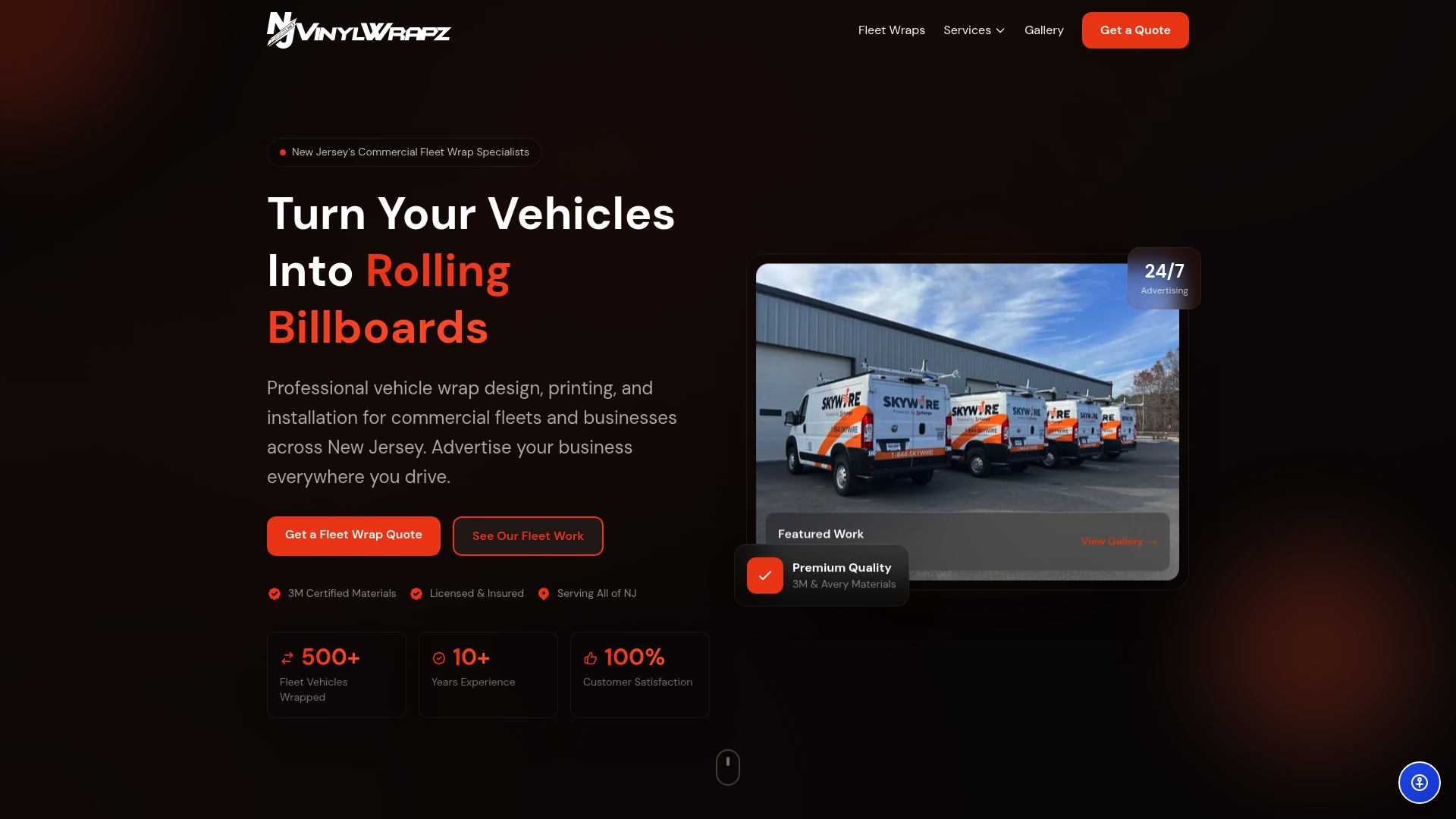
Services include full vehicle wraps, vehicle lettering, fleet programs, color-change wraps, window graphics, PPF, and ceramic coatings. To get a quote, send your vehicle’s make, model, year, VIN, and four photos. Njvinylwrapz will come back with a written estimate broken down by line item, not a single number you have to take on faith.
Useful sources
- How to Calculate Wrap Cost by Square Footage — We Print Wraps: Best for understanding waste factor math, material tiers, and labor-to-$/sq ft conversion.
- Vehicle Wrap Pricing: Real Costs, Calculator and Price Factors — Original Pricing: Useful for total project ranges by vehicle type and specialty finish cost impacts.
- Vehicle Wrap Cost Calculator — WrapSize: Interactive calculator for estimating material and labor by vehicle; also covers PPF vs vinyl cost comparison.
- How Much Does It Cost to Wrap a Car? — Kelley Blue Book: Authoritative consumer reference for total wrap cost ranges by vehicle segment and regional labor variation.
- Vehicle Wrapping Cost and Price Ranges Guide — Cost Insider: Covers installer quality impacts on lifespan and paint safety; good for warranty and certification context.
- Njvinylwrapz Wrap Options: Details on 3M and Avery Dennison material partnerships and available finishes.
- Njvinylwrapz Fleet Wrap Guide: Fleet-specific considerations including protection use cases and volume program structure.
- AutoROIQ Automotive Marketing Insights: Industry-level data on fleet marketing efficiency and mobile advertising cost-effectiveness.
FAQ
Is it cheaper to wrap a car than to paint it?
Yes, in most cases. A mid-quality full wrap typically costs a few thousand dollars less than comparable paint, and the wrap protects the factory finish underneath, which helps resale value.
How long will a wrap last on a car?
Premium cast vinyl lasts 5–7 years with proper care; economy calendered vinyl typically holds up 2–3 years. Garaged storage, hand-washing, and avoiding high-pressure jets on seams extend lifespan noticeably.
What is the downside of wrapping a car?
Wraps don’t hide dents, deep scratches, or paint defects — they often make them more visible. A low-quality installation can also damage paint at removal, which is why installer certification matters as much as the material grade.
Which is better, PPF or a wrap?
They solve different problems. PPF (paint protection film) is designed to absorb stone chips and impact damage and costs significantly more per square foot. Vinyl wrap is lower-cost and better suited for color changes, branding, and cosmetic customization. Some owners use both: wrap for appearance, PPF on high-impact areas like the hood and front bumper.