
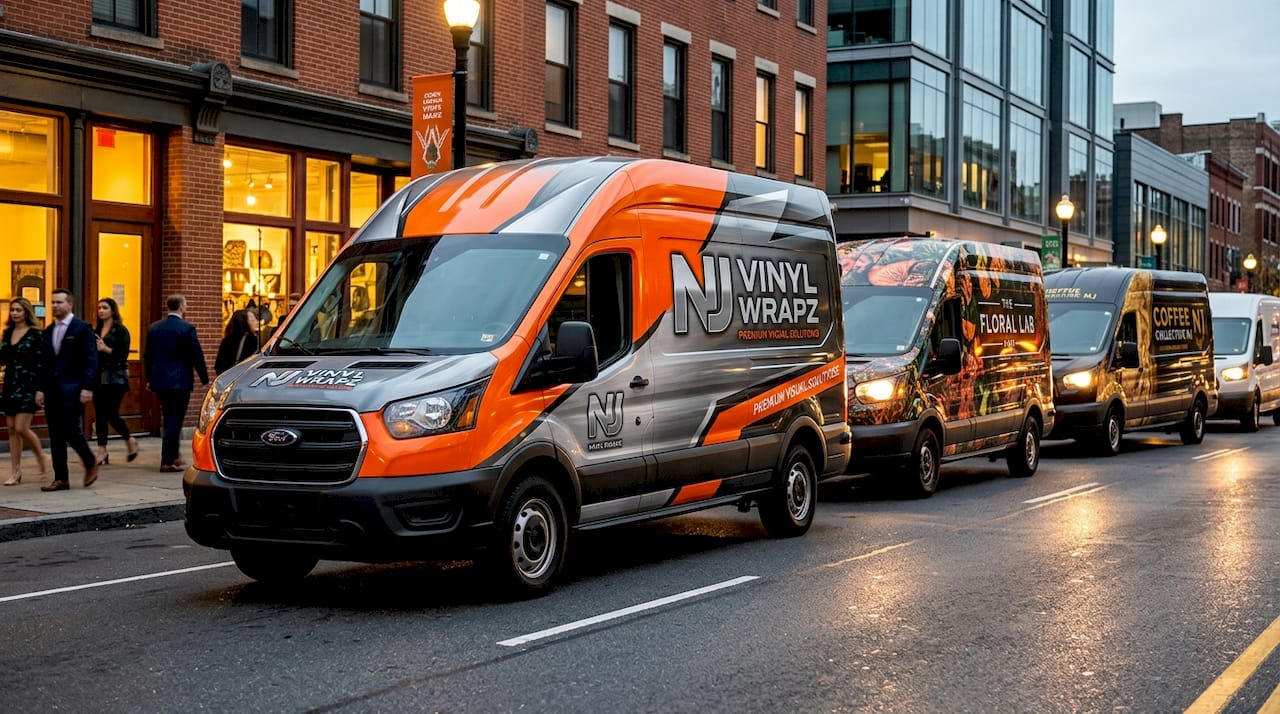
Vehicle advertising is defined as a mobile marketing method where businesses apply promotional graphics, wraps, or decals to vehicles, turning them into moving billboards that generate brand exposure across every route they travel. Unlike a static billboard locked to one intersection, a wrapped delivery van or branded fleet truck reaches neighborhoods, highways, and commercial districts simultaneously. The industry term for the most effective format is vehicle wrap advertising, and it covers everything from full vinyl wraps to rear-window graphics. Platforms like AdQuick and Carvertise have built entire campaign management systems around this channel, and material suppliers like 3M and Avery set the quality standard for wrap durability. If you are evaluating mobile advertising solutions for your business, this guide covers every dimension you need to make a confident decision.
What is vehicle advertising and how does it work?
Vehicle advertising uses vehicles as moving billboards through wraps, decals, magnetic signs, and window graphics applied directly to the vehicle surface. The core mechanic is simple: as the vehicle travels its normal route, every person who sees it becomes an impression. A single wrapped vehicle in a mid-size market can generate 30,000 to 70,000 daily impressions depending on coverage type and how many hours the vehicle operates. That reach rivals many digital display campaigns at a fraction of the recurring cost.
The three main wrap formats
The format you choose determines both your visual impact and your budget. Here is how each one works in practice:
- Full vehicle wrap: Vinyl graphics cover the entire exterior surface, hood to bumper. This format delivers the highest visual impact and the broadest impression count. A plumbing company running five fully wrapped vans across New Jersey effectively operates five mobile billboards every working day.
- Partial vehicle wrap: Graphics cover 25% to 75% of the vehicle, typically the sides and rear. This is the most popular format for small businesses because it balances cost with visibility. A partial wrap on a single-door cargo van still commands attention at traffic lights and in parking lots.
- Rear-window and decal placements: These are the entry-level option, covering only the back glass or specific panels with lettering and logo graphics. Rideshare and delivery platforms like Carvertise use this format for driver recruitment campaigns because installation is fast and reversible.
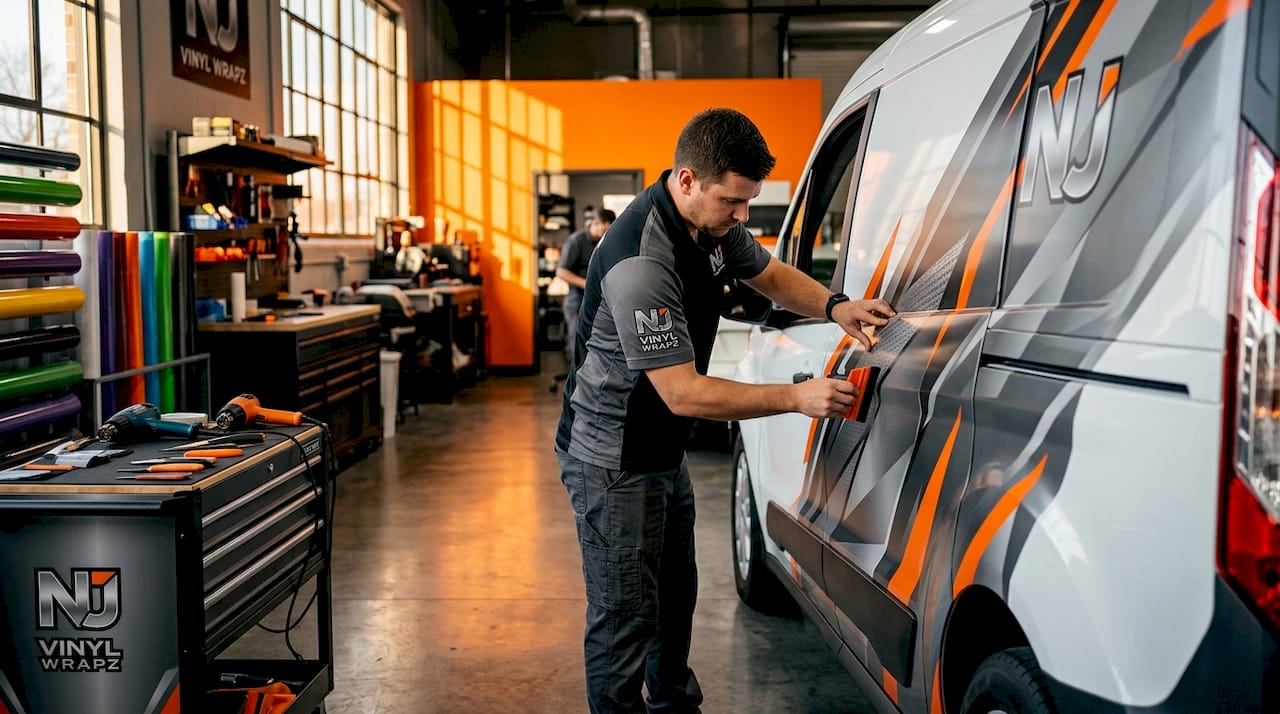
The production process follows three steps: custom design, large-format printing on vinyl film, and professional installation. Reputable installers work in climate-controlled facilities to prevent bubbling and peeling, which directly affects how long the wrap lasts. Skipping professional installation is the most common mistake businesses make when entering this channel.
Pro Tip: GPS tracking tools built into fleet management software let you verify that wrapped vehicles are actually traveling high-traffic corridors. Route data combined with impression modeling gives you a real number to report to stakeholders.
What are the key benefits of vehicle advertising compared to traditional outdoor ads?
Vehicle advertising offers wider geographic reach and audience diversity than stationary billboards, because mobility lets a single ad unit reach multiple neighborhoods, demographics, and traffic patterns in one day. A billboard on Route 9 in New Jersey reaches only the drivers who use that road. A wrapped fleet vehicle covers Route 9, downtown Trenton, a suburban strip mall, and a warehouse district before noon.
| Factor | Vehicle advertising | Traditional billboard |
|---|---|---|
| Geographic reach | Multiple locations daily | Fixed to one location |
| Audience diversity | Varies by route | Limited to passing traffic |
| Campaign duration | 5 to 7 years per wrap | Monthly or annual lease |
| Recurring cost | None after installation | Ongoing rental fees |
| Targeting flexibility | Route-based, adjustable | Fixed placement only |
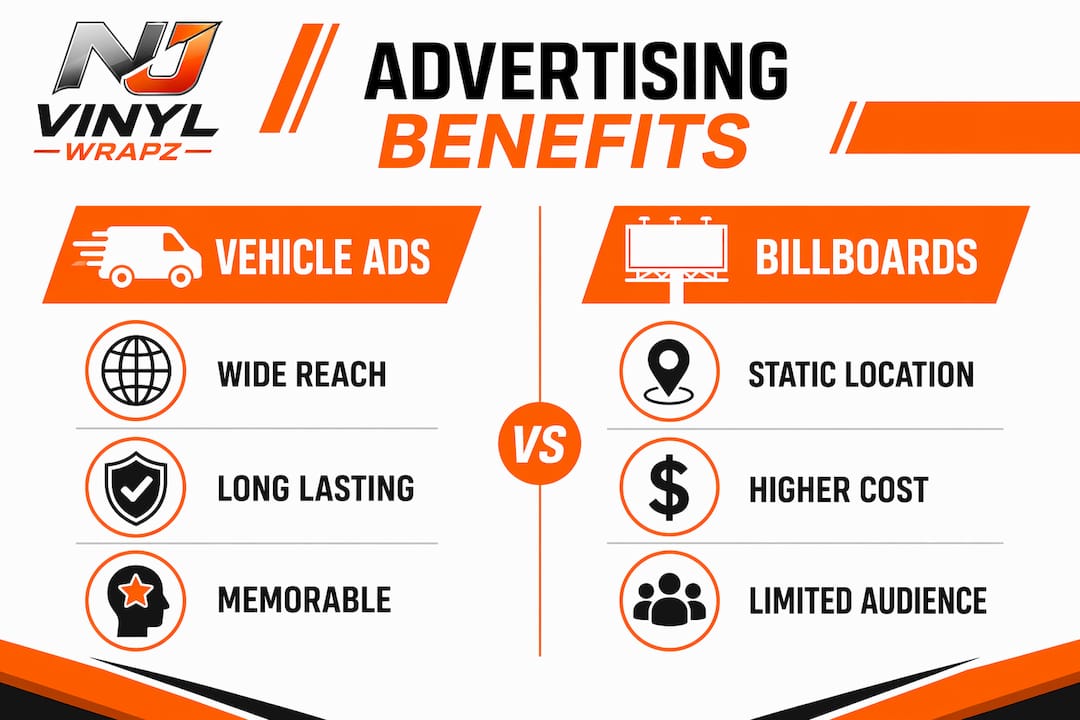
Vehicle wraps last about 5 to 7 years with quality materials, meaning one installation investment delivers continuous advertising value for years without a renewal invoice. That durability fundamentally changes the cost-per-impression math compared to digital ads that charge you every month whether or not the campaign performs.
Memorability is another measurable advantage. A moving, visually bold vehicle graphic is harder to ignore than a banner ad a viewer has trained themselves to skip. The commercial wraps benefit extends beyond impressions: consistent fleet branding builds brand recognition in the specific service areas where your customers actually live and work.
Pro Tip: If you operate in a defined service territory, map your most common job routes and calculate how many residential neighborhoods those routes pass through. That number is your organic impression zone, and it costs you nothing extra once the wrap is installed.
What are the typical costs and pricing models for vehicle advertising?
Pricing for vehicle advertising breaks down cleanly by format. Full wraps run $1,500 to $3,500, partial wraps cost $800 to $1,800, and rear-window placements range from $150 to $400. These are one-time production and installation costs, not recurring fees.
| Format | Typical cost | CPM range | Best for |
|---|---|---|---|
| Full vehicle wrap | $1,500 to $3,500 | $0.50 to $1.50 | Maximum brand presence, fleet branding |
| Partial vehicle wrap | $800 to $1,800 | $1.00 to $2.50 | Small businesses, budget-conscious campaigns |
| Rear-window placement | $150 to $400 | $2.00 to $4.00 | Entry-level testing, rideshare campaigns |
CPM (cost per thousand impressions) ranges from $0.50 to $4.00 depending on wrap type and market density. The counterintuitive finding here is that rear-window placements carry the highest CPM despite being the cheapest format, because their lower impression volume means each thousand impressions costs more relative to a full wrap. Full wraps deliver the lowest CPM at scale, which is why fleet wrap options become dramatically more cost-efficient as you add vehicles.
Choosing wrap placement affects CPM and break-even points, so the right format depends on your conversion goals, not just your budget. A service business that needs name recognition in a specific zip code gets more value from a full wrap on one vehicle than from rear-window decals on five.
Pro Tip: Divide your total wrap cost by the number of months in a 5-year lifespan (60 months) to get your monthly advertising cost. A $2,500 full wrap costs roughly $42 per month. Compare that to what you spend on a single Google Ads day.
How can you plan, measure, and optimize vehicle advertising campaigns?
Planning a vehicle advertising campaign starts with impression modeling, not creative design. Route and impression modeling combines vehicle operating time, distance, and coverage to estimate campaign reach before you spend a dollar on production. Tools like AdQuick’s impression calculator let you input daily driving hours and market density to project monthly impressions with reasonable accuracy.
Measurement tools have matured significantly. GPS tracking and attribution tools provide route and performance analytics including impressions, store visit lift, website traffic spikes, and geofencing data. Here is what a well-structured measurement plan looks like:
- Baseline tracking: Record website traffic, phone call volume, and in-store visits for 30 days before launch. This is your control period.
- GPS route verification: Confirm wrapped vehicles are traveling planned high-traffic corridors. Route drift is common without active monitoring.
- Geofencing attribution: Set digital geofences around key service areas and track whether mobile device activity near your vehicles correlates with website visits or calls.
- Heat mapping: Use route heat maps to identify which corridors generate the most impressions per hour. Shift routes toward high-density zones to improve efficiency.
- Impression reporting: Calculate monthly impressions using time on road, average speed, and traffic density. Report this as a CPM metric to align with how your other media buys are measured.
Rideshare and delivery vehicle campaigns offer better targeting and measurable analytics than traditional transit advertising because GPS data is granular and real-time. For businesses running their own fleet, the same principle applies: treat your vehicles as media assets with trackable performance, not just transportation.
What design and messaging considerations make vehicle advertising effective?
Effective vehicle ad design requires high contrast, clear hierarchy, and brief messages that a driver or pedestrian can read in under three seconds. A vehicle moving at 35 mph gives a viewer roughly two to four seconds of viewing time. Every design decision must serve that constraint.
Follow this priority order when building your creative:
- Brand name and logo first. This is the non-negotiable anchor. If a viewer remembers nothing else, they remember who you are.
- Core offer or category second. “Plumbing,” “HVAC,” “Commercial Cleaning” tells the viewer what you do without requiring them to read a paragraph.
- Call to action third. A phone number or website URL in large type gives an interested viewer something to act on. QR codes work well on rear-window placements where stopped traffic has time to scan.
- High-contrast color palette throughout. Dark text on light backgrounds or light text on dark backgrounds. Avoid gradients that reduce legibility at distance.
- Minimal clutter as a design rule. Every element you add competes with every other element. A wrap with five messages communicates none of them clearly.
The design difference between a full wrap and a partial wrap is surface area, not strategy. Both formats follow the same hierarchy. The advantage of a full wrap is that you have more space to reinforce the brand visually with photography, patterns, or color fields that make the vehicle unmistakable. For fleet vehicle customization, consistency across all vehicles in the fleet multiplies the recognition effect: seeing the same branded truck three times in a week feels like three separate ad exposures.
Key takeaways
Vehicle advertising delivers the lowest cost-per-impression of any outdoor media format when wrap lifespan is factored into the calculation.
| Point | Details |
|---|---|
| Definition and reach | Vehicle advertising turns any vehicle into a mobile billboard generating up to 70,000 daily impressions. |
| Format determines CPM | Full wraps offer the lowest CPM at scale; rear-window placements cost less upfront but carry higher CPM. |
| Long-term cost advantage | A quality wrap lasts 5 to 7 years, making the monthly advertising cost far lower than recurring digital spend. |
| Measurement is possible | GPS tracking, geofencing, and impression modeling give vehicle campaigns measurable, reportable analytics. |
| Design drives results | Readable, high-contrast creative with a clear brand-offer-CTA hierarchy is the difference between noticed and ignored. |
Why vehicle advertising is underrated by most marketing budgets
I have worked with businesses that spend $3,000 a month on Google Ads for a service area covering 20 zip codes, and they have never once considered putting that same $3,000 into a full wrap on their most-used work truck. The math rarely gets run, and that is the real problem.
Here is what I have observed consistently: vehicle advertising performs best for businesses where the vehicle itself is already proof of the service. A landscaping company, an HVAC contractor, a commercial cleaning fleet. The truck going to the job site is already in the neighborhood. The wrap just makes that presence work harder.
The common pitfall I see is businesses treating wrap design like a business card. They pack in the tagline, the license number, the social handles, and the founding year. None of that survives a three-second viewing window. The businesses that get the most out of this channel treat the vehicle like a billboard: one brand, one offer, one number.
The other underrated angle is fleet consistency. One wrapped vehicle is a marketing asset. Five identically branded vehicles operating in the same territory become a brand presence that feels much larger than the company actually is. That perception of scale matters enormously for winning commercial contracts.
My honest advice: budget vehicle advertising on CPM the same way you budget digital media. Run the numbers on wrap ROI before dismissing it as a one-time expense. When you see $42 per month for a full wrap versus $150 per day for paid search, the conversation changes quickly.
— Krunal
Turn your fleet into a branded advertising asset with Njvinylwrapz
If the numbers in this guide have you reconsidering your fleet’s marketing potential, Njvinylwrapz is the right place to start. With over 10 years of experience wrapping commercial fleets across New Jersey, Njvinylwrapz uses 3M and Avery vinyl materials installed in climate-controlled facilities to deliver wraps that last and perform.
Whether you need a single full vehicle wrap for a standout service truck or a consistent brand identity across an entire commercial fleet, Njvinylwrapz handles design, printing, and installation under one roof. Contact Njvinylwrapz today to get a quote and see how your vehicles can start working as your most cost-efficient advertising channel.
FAQ
What is vehicle advertising in simple terms?
Vehicle advertising is a marketing method where businesses apply branded graphics, wraps, or decals to vehicles so they function as moving billboards. Every mile the vehicle travels generates brand impressions at no additional cost.
How long does a vehicle wrap last?
A professionally installed vehicle wrap using quality vinyl materials lasts approximately 5 to 7 years. Proper installation in a climate-controlled environment and routine washing extend that lifespan.
How much does vehicle wrap advertising cost?
Full wraps typically cost $1,500 to $3,500, partial wraps run $800 to $1,800, and rear-window placements start at $150. These are one-time costs with no recurring fees, unlike digital or billboard advertising.
Can vehicle advertising campaigns be measured?
Yes. GPS tracking, geofencing, and impression modeling tools provide route data, estimated impressions, and store visit attribution. Platforms like Carvertise and AdQuick offer built-in analytics for managed campaigns.
Is vehicle advertising better than a billboard?
Vehicle advertising reaches multiple locations and demographics daily, while a billboard is fixed to one location. For businesses operating in a defined service territory, a wrapped fleet vehicle typically delivers more relevant impressions per dollar than a static outdoor placement.